
A compact check valve can solve a space problem while introducing a different flow or installation constraint. Replacing a swing check with a dual-plate design therefore needs more than a matching size and class.
Compare the actual passage, disc travel, operating flow range and dynamic response. A spring-assisted dual-plate valve can have useful closure characteristics, but its name alone does not guarantee a surge-free system.
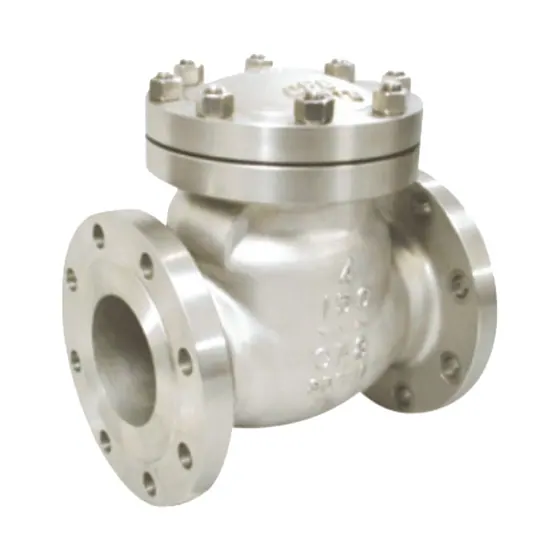
The mechanical difference that matters
A swing check normally uses a hinged disc that moves away from its seat under forward flow. A dual-plate design divides the closure into two plates; many designs use springs to assist return toward the seat. The body arrangement and internal parts vary by manufacturer.
These differences affect travel, installation envelope and response to changing flow. They do not establish a universal closing time. For a primary manufacturer's discussion of check-valve types and installation considerations, see Spirax Sarco's check-valve guide.
The key comparison is the proposed design under the required duty. Two valves within one category can have different spring selections, pressure losses and orientation restrictions.
First check whether the installation really fits
A wafer body is held between mating flanges. Confirm the required flange standard, facing, bore, gasket arrangement and bolting for the actual valve. Wafer, lug and double-flanged are connection descriptions, not interchangeable installation approvals.
Pay particular attention to the moving plates or disc. Parts may project beyond the body during opening. Nearby pipe liners, reducers, gasket intrusion or an adjoining valve can limit movement even if the face-to-face dimension fits the available gap.
| Layout check | Required information |
|---|---|
| Installed length | Approved face-to-face drawing and tolerance |
| Disc/plate movement | Full-open envelope and adjoining clear bore |
| Flange interface | Standard, facing, gasket and bolting arrangement |
| Orientation | Manufacturer-approved direction and shaft/body position |
| Support and access | Assembly mass, piping support and removal route |
Do not assume vertical-down suitability from the presence of a spring. The offered model's instructions and performance information control the orientation decision.
Size for the flow range, not only pipe diameter
A check valve responds to the fluid forces acting on its closure. At an inadequate forward flow, a selected design may not remain in its intended stable position. The resulting movement can cause wear or noise; oversizing the passage can make the minimum-flow question more important.
Give the supplier minimum, normal and maximum flow, fluid state and density, pressure, temperature and relevant operating combinations. A multi-pump header needs the combinations with one pump operating as well as the maximum combined flow. Ask for pressure loss and stable operating information for the actual selection.
A pressure-loss value at maximum flow does not answer low-flow stability. A low cracking pressure does not establish that a disc will remain fully open throughout the duty. Retain those as different entries in the review.
Closure is a system question
When forward flow decelerates, the valve must respond as the fluid forces change. How much reverse flow develops before closure depends on the valve and the system. The sudden change in velocity can create a pressure transient; a spring label alone does not calculate that transient.
For a duty with a pump trip or known surge concern, request the relevant dynamic characteristic and provide the system deceleration or transient-study requirements. A generic claim such as “closes in 0.05 seconds” is not enough without its test and application basis.
This is the difference between comparing mechanisms and approving a system. The ZGV pump-discharge guide addresses the broader pump-station review. This article focuses on the specific dual-plate versus swing-check replacement decision.
A hypothetical retrofit with two independent checks
Suppose an existing swing check occupies a long spool and a compact dual-plate replacement is proposed. The approved layout review confirms the new body length, mating bore and plate travel. That closes the mechanical-fit item.
The station also operates at a reduced single-pump flow overnight. The supplier must now assess the proposed valve at that flow and the required orientation. A favourable full-flow pressure loss does not close this second item. If a pump-trip study is required, dynamic closure becomes a third, separately documented approval.
This sequence can avoid a common mistake: treating space savings as proof that the whole replacement is suitable.
Materials, dirt and inspection still matter
State relevant solids, fouling, corrosion and temperature conditions. Springs, hinge parts and seats are exposed components with their own limits. Do not label either valve family universally superior for every slurry or contaminated service.
Agree the required leakage test and acceptance basis for the offered seat construction. Keep the inspection and maintenance instructions with the identified model. Work on an installed check valve follows approved isolation and depressurisation arrangements; an automatic closure device is not a substitute for a maintenance isolation plan.
Prepare the manufacturer enquiry
ZGV publishes a 2553 swing-check reference. Use the reference, service data and installed drawing to start the discussion. If a dual-plate alternative is requested, ask ZGV to identify an available model and supporting data rather than infer it from an unrelated catalogue entry.
Send the flow range and installation envelope with the required closure and leakage criteria. A useful offer will answer fit, steady operation and dynamic response separately.
ZGV VALVE · Request a quotation · WhatsApp +86 13732021078
Download the ZGV valve RFQ template and attach your service conditions and required inspection documents.