
“Tested to API 598” is a useful starting statement. An acceptance decision still needs the valve identity, applicable test, conditions, result and agreed acceptance criterion.
A useful report links each result to an identified valve and an agreed requirement. Establish that acceptance basis before testing, then carry it through the inspection plan and final records so purchasing, quality and the supplier can review the same evidence.
Name the question each test answers
| Test or evidence category | Question it addresses | Information it does not establish by itself |
|---|---|---|
| Shell pressure test | Whether the specified pressure boundary meets the applicable test acceptance requirements | Seat tightness at every operating condition |
| Closure or seat test | Leakage across the specified closed flow path under the defined conditions | External stem-seal emissions throughout service |
| External leakage qualification | Performance of the relevant stem/shaft seals and body joints within the qualification scope | Every delivered valve’s complete production-test result |
| Fire type-test evidence | Performance of a qualified design under the applicable fire-test programme | A routine test performed on every valve in the order |
| Order-specific production report | Recorded results linked to the identified supplied valves | Qualification for unrelated designs, sizes or materials |
Scroll the table horizontally on a small screen.
ISO 5208’s public scope covers metallic valve pressure-boundary integrity, closure tightness and structural adequacy of the closure mechanism, in conjunction with the relevant product standard. That scope explains why the named test and applicable product requirements matter. ISO 5208 official description
External leakage is a separate subject. ISO 15848-1 addresses type testing of stem or shaft seals and body joints within its stated scope. A seat-leakage result should not be used as evidence for that different leakage path. ISO 15848-1 official scope
Record the standard and edition before manufacture
The edition needs to be identifiable in the order and inspection documentation. “Latest edition” is less clear if the quotation, order and test take place at different times. Agree the governing documents and any applicable amendments before the inspection plan is approved.
At the research date of 16 October 2026, the public publisher records show:
| Public reference | Status visible in the publisher’s record |
|---|---|
| API 598 | Edition 11 published 8 February 2023; edition 12 appears in the development section |
| ISO 5208:2015 | Edition 4; reviewed and confirmed in 2025; Amendment 1 shown as under development |
| ANSI/FCI 70-2-2021 | Listed by FCI for control valve seat leakage testing |
Scroll the table horizontally on a small screen.
Sources: API standards plan and published list, ISO 5208 record and FCI control valve standards.
A development entry is not a published edition to cite as already in force. These publisher records also do not replace the actual standards needed to determine the requirements of a particular order. Use the agreed product and test standards, including the applicable conditions and exceptions, rather than inventing a universal test duration or acceptance rate.
Read catalogue test pressures as catalogue data
ZGV’s lift type metal seated plug valve page publishes the following test-pressure entries.
| Catalogue Class designation | Shell test MPa | Sealing test MPa |
|---|---|---|
| 150 | 3.0 | 2.2 |
| 300 | 7.5 | 5.5 |
| 600 | 15.0 | 11.0 |
| 900 | 22.5 | 16.5 |
Scroll the table horizontally on a small screen.
Source: ZGV product 2573 performance specification. Values reproduce the published catalogue fields. They are not an order-specific report, a temperature-dependent operating rating or independent confirmation of compliance with a particular edition of a test standard.
For example, the Class 150 row separates shell and sealing test pressures. Copying only 3.0 MPa into a generic “test pressure” field would lose which test it belongs to. The report should preserve that distinction and state the actual conditions and acceptance basis used.
For order approval, reconcile the proposed test procedure with the governing standard and configuration. Do not turn a rounded catalogue value into a complete instruction for carrying out a pressure test.
Define leakage in a way that can be checked
An acceptance requirement should identify the flow path or boundary, test medium, pressure, direction where applicable, temperature, duration, measurement method and permitted leakage under the governing procedure. Some of these details may be supplied by the agreed standard; others may need explicit project definition.
The measurement units matter. Bubbles per minute, a liquid volume per unit time and a measured gas flow are different descriptions. A bare number such as “0.0” is incomplete without its unit, method and reporting basis. The absence of observed leakage during a defined test is also a different statement from an unlimited service guarantee.
FCI explains control-valve seat leakage classes as maximum-leakage benchmarks under defined test conditions. A Class VI label should therefore remain attached to its applicable procedure and test conditions. It should not be used as a synonym for every form of leak-free isolation. FCI ANSI/FCI 70-2 informational sheet
Where the project needs a condition beyond the routine production test—such as an agreed hot test, cycle qualification or a particular external-leakage class—identify it separately. The supplier can then confirm the evidence and the scope rather than assuming that one cold test answers all of those questions.
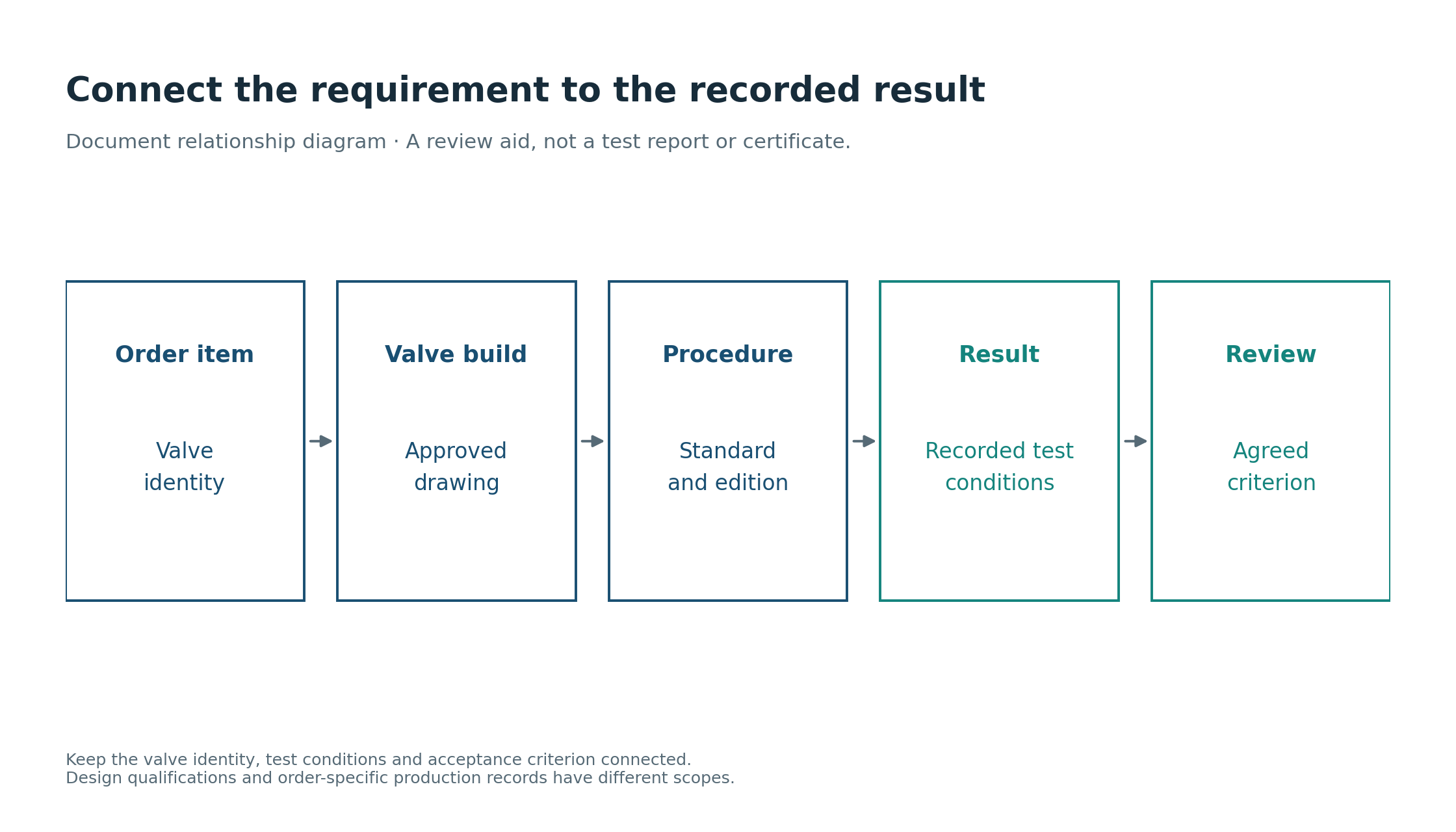
Swipe or scroll horizontally to see the full diagram.
Review a report by finding what is missing
The following entries are fictional review examples, not ZGV test records.
| Example statement in a document | Why the reviewer needs more information |
|---|---|
| “Pressure test passed” | The valve identity, test category, conditions and acceptance criterion are not identified |
| “Seat leakage 0.0” | The unit, medium, method, duration and reporting basis are missing |
| “API 598 latest” | The agreed edition is unclear and the individual applicable tests are not shown |
| “Class VI, all conditions” | A defined control-valve seat test has been expanded into an unsupported service claim |
| “Certificate attached” | The document still needs to be linked to the offered design or identified supplied valves |
Scroll the table horizontally on a small screen.
The remedy is to complete the evidence, not simply add more certificates. A short report with identifiable conditions and traceability can be more useful than a large bundle in which the valve identities and qualification scopes do not connect.
Wording for the purchase specification
The following wording is a procurement example to complete with the project’s governing documents and approved requirements:
For each valve identified in the approved supply schedule, perform the applicable production tests to the agreed product standard, test standard and approved procedure. Record each test separately with valve identification, test medium, pressure, direction where applicable, temperature, duration, measured or observed result, and the applicable acceptance criterion. Provide the agreed traceability and witness records. Identify deviations for disposition before release.
This describes the information chain without inventing a leakage threshold or test duration. Those values must come from the applicable requirements. Missing information in a submitted document is a reason to clarify the evidence; it does not, by itself, prove that the physical valve failed a test.
Keep identification consistent through the test package
The purchaser’s item or tag, supplier model, size, pressure class, materials and serial or batch references should connect the order, drawing and test report. Where material certificates form part of the order, their identifiers should connect to the required parts and the agreed traceability scheme.
The report also needs the information necessary to review the measurement: relevant procedure, instrument identification or calibration references as required, actual result, date and responsible approval. A calibration document is useful only if it can be connected to the measurement for which it is being offered.
Witness and hold arrangements should be agreed in the inspection and test plan, including the notice and release process required by the project. They should be clear before the factory reaches the relevant stage. Adding an unspecified witness expectation after testing can create avoidable uncertainty about what evidence is acceptable.
For a ZGV enquiry, use the published product specification to identify the starting configuration, then ask the supplier to return the proposed inspection and test plan and report format for the actual order. Resolve deviations and any additional qualification needs before the plan is approved.
The final evidence should allow a reviewer to answer a plain question: which requirement was checked, on which valve, under which conditions, and with what result?
Use the valve RFQ worksheet to identify the enquiry, then attach the proposed acceptance requirements and request the inspection plan and report format before order approval. You can discuss the proposed inspection requirements with ZGV.