
Compare the duty, materials, installation dimensions and quotation scope before placing an order.
At NPS 2 and Class 300, ZGV's published floating and trunnion mounted full-bore ball valves both list L as 216 mm. Their H dimensions are 148 mm and 165 mm respectively. For a replacement with limited clearance, that 17 mm difference needs attention even though the connection length matches.
It is one reason an industrial valve enquiry needs more than a size and pressure class. The seat compound, operator and required inspection records also belong in the comparison. This guide starts with the choice of valve family, then uses four published ZGV ball valve configurations to work through those purchasing questions.
Download the editable valve RFQ template
Use one RFQ sheet for each valve tag or group of identical specifications. The second sheet compares three supplier offers.
The duty comes before the valve family
Isolation, regulation and prevention of reverse flow place different demands on a valve. Establishing the required function narrows the choice of family; the proposed design can then be assessed against the service conditions.
Swipe horizontally to see all columns.
| Valve family | Typical duty | Reason to consider it | Selection issue |
|---|---|---|---|
| Ball valve | Line isolation | Quarter-turn operation with full or reduced bore options | Seat suitability and operating torque; continuous throttling needs a design intended for that duty |
| Butterfly valve | Isolation or regulation with a suitable design | Compact rotary construction | Seat compatibility, disc clearance and the intended control conditions |
| Gate valve | Fully open or fully closed isolation | The closure retracts from the principal flow path | Opening height and sealing arrangement; routine throttling calls for a different selection |
| Globe valve | Regulation or isolation with suitable trim | Stem travel changes the opening at the seat | Pressure loss, trim selection and the actuator travel and force required |
| Check valve | Prevention of reverse flow | Automatic response to flow | Minimum flow, orientation and closure behaviour during system transients |
For regulating service, the selected design needs to be sized for the flow and pressure-drop cases. The family name alone leaves that work unresolved. Leaving an isolation ball valve partly open does not establish its suitability for continuous control. A check valve also cannot be treated as a substitute for a maintenance isolation valve.
The rotary valve, linear valve and check valve tutorials from Spirax Sarco explain the operating principles behind these distinctions. The numerical comparisons later in this guide concern ball valves only.
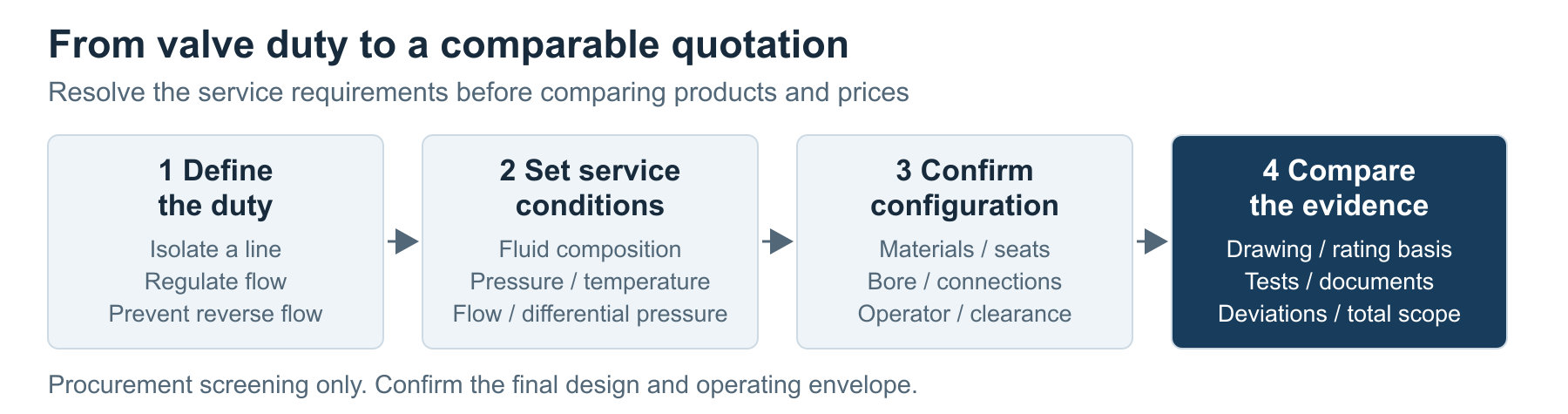
Service conditions that change the specification
Normal operating conditions are only part of the enquiry. Start-up, shutdown and cleaning can expose a valve to a different temperature, pressure or fluid composition. A seat compound that suits the process fluid therefore also needs checking against the cleaning medium.
Pressure on each side of the valve matters. The actuator must be selected for the pressure difference it will actually have to overcome when moving the valve, including the specified worst case. Stating a pressure class without that duty information leaves part of the operator selection unresolved.
For regulation, the supplier needs minimum, normal and maximum flow cases with the corresponding pressure drops. For isolation, shutoff requirements and cycling frequency take priority. Check valve selection needs the flow range and installation orientation so the proposed design's closure response can be assessed.
The datasheet needs fluid composition and solids, along with operating and design pressures and temperatures. Units and gauge or absolute pressure should be identified. Standard-volume gas flow also needs its reference conditions. When information is missing, a named clarification owner is more useful than an assumed value. Every bidder should receive the same datasheet revision.
Ball valve construction and material choices
ZGV lists both floating and trunnion mounted ball valves in the pressure classes shown below. Pressure class alone therefore cannot select the support arrangement.
Swipe horizontally to see all columns.
| ZGV reference | Construction | Published classes | Published full bore size rows in NPS |
|---|---|---|---|
| 2511 | Two-piece floating | 150 and 300 | 1/2 through 8 in both class tables |
| 2512 | Two-piece floating | 600 and 900 | 1/2 through 3 in both class tables |
| 2514 | Two-piece trunnion mounted | 150 and 300 | 2 through 24 in both class tables |
| 2515 | Two-piece trunnion mounted | 600 and 900 | 2 through 24 in both class tables |
Source: the four linked ZGV product pages, reviewed on 16 October 2026. Size spans describe the published Full bore rows, not guaranteed availability in every configuration. Reduced bore tables are separate. The numbers 2511 through 2515 identify website entries; the quotation needs the actual engineering model. Class is a pressure-rating designation, not a direct value in psi or bar.
An NPS 6 Class 600 enquiry illustrates how the size information helps. The published 2515 table includes that size; the 2512 Full bore table stops at NPS 3. A buyer has a catalogue row to examine for the trunnion option and needs ZGV to confirm any floating alternative at NPS 6. The absence of a row does not establish that ZGV cannot supply it.
In a floating construction, differential pressure can move the ball against its sealing arrangement. A trunnion mounted ball is mechanically supported. That changes how pressure loads are carried, but neither description settles the suitability of the seats or the torque required to operate the offered valve.
At Class 600, the catalogue provides a floating option as well as a trunnion option. A buyer concerned about operating effort needs torque data for the offered size and duty to compare them. A purchaser replacing an existing valve also needs the assembly dimensions. The class number resolves neither question. ZGV's floating versus trunnion design guide covers the mechanical distinction in more detail.
Component materials need separate attention
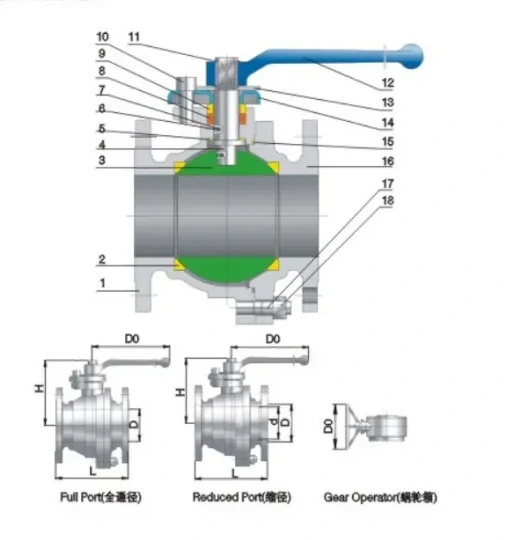
The component comparison adds detail that a body-material description leaves open.
Swipe horizontally to see all columns.
| Component | 2511 | 2512 | 2514 and 2515 Standard column |
|---|---|---|---|
| Body | ASTM A216 Gr.WCB | ASTM A105 | ASTM A216 WCB |
| Ball | 304 S.S. | 304 S.S. | ASTM A105/ENP |
| Stem | ASTM A182 F6a | ASTM A182 F6a | ASTM A182 F316 |
| Seat seal or insert | PTFE | R-PTFE | 25% Glass-filled PTFE |
| Packing | PTFE | PTFE | Graphite |
Source: the material tables on the four product pages. Names and abbreviations follow the catalogue; the 2514 and 2515 values are from the Standard column.
The 2511 material table pairs a WCB body with a 304 stainless steel ball, an ASTM A182 F6a stem and a PTFE seat seal. Calling this a stainless steel valve on the strength of the ball material would misdescribe the assembly. Equally, the body grade does not answer a question about seat compatibility.
The supplier's material schedule should identify the seat compound as well as the body, trim, packing, gaskets and bolting. A seat compound outside the specified service conditions is a reason to reject that configuration or request a documented alternative.
The trunnion material tables also list ASTM A351 CF8M bodies in the Stainless steel column and ASTM A352 LCB bodies in the Low-temperature service column. The same tables retain the 25% glass-filled PTFE seat insert across those columns. A change of body material therefore still needs a review of the complete seat and seal arrangement; it does not provide a complete valve temperature rating.
Full bore and reduced bore also need to be distinguished in the offer. Where pressure loss affects the decision, size-specific Cv or Kv flow-capacity data provides a basis for comparison. A bore label alone cannot substantiate a pressure-loss or energy-saving claim.
Installation dimensions and clearance
For the selected NPS 2 Full bore rows, all four catalogue entries list D as 51 mm. Their L and H dimensions differ as follows. The letters retain the labels used in the source drawings.
Swipe horizontally to see all columns.
| Class | Both L mm | Floating H mm | Trunnion H mm | H difference mm | Floating weight kg | Trunnion weight kg |
|---|---|---|---|---|---|---|
| 150 | 178 | 142 | 165 | 23 | 15.6 | 17 |
| 300 | 216 | 148 | 165 | 17 | 25.0 | 18 |
| 600 | 292 | 151 | 176 | 25 | 15.0 | 27 |
| 900 | 368 | 178 | 192 | 14 | 39.0 | 52 |
Source: the linked 2511, 2512, 2514 and 2515 tables. The difference is trunnion H minus floating H. The listed operator arrangements also differ; these figures compare catalogue configurations rather than isolate the effect of ball support. H is not the total assembly height. Weights are catalogue values; inclusion of the final operator and shipping packaging is not defined in these tables and needs confirmation for handling or freight calculations.
At Class 300, the trunnion row has a higher H dimension but a lower listed weight than the floating row: 18 kg compared with 25.0 kg. Clearance and handling requirements therefore need separate checks against the offered assembly. The support label alone cannot settle either.
Consider an illustrative Class 300 replacement requiring L of 216 mm and a preliminary H limit of 160 mm. The 2511 row gives H as 148 mm, within that limit. The 2514 row gives 165 mm, exceeding it by 5 mm. The second option needs a clearance review or a different confirmed arrangement even though both entries match L.
The example is an illustrative dimensional check; suitability for the fluid and operating conditions remains to be assessed. Installation acceptance also needs the final assembly drawing, including the operator, lever sweep and maintenance clearance.
Certificates and order inspection records
A supplier certificate is useful when it can be connected to the product being offered. ZGV's quality page groups management systems, production licences, industry documents and type-test materials separately. A management-system certificate and a product type-test certificate serve different purposes; the order still needs its agreed inspection records.
The published ball valve type-test certificate provides a concrete example of what can be checked before an order.
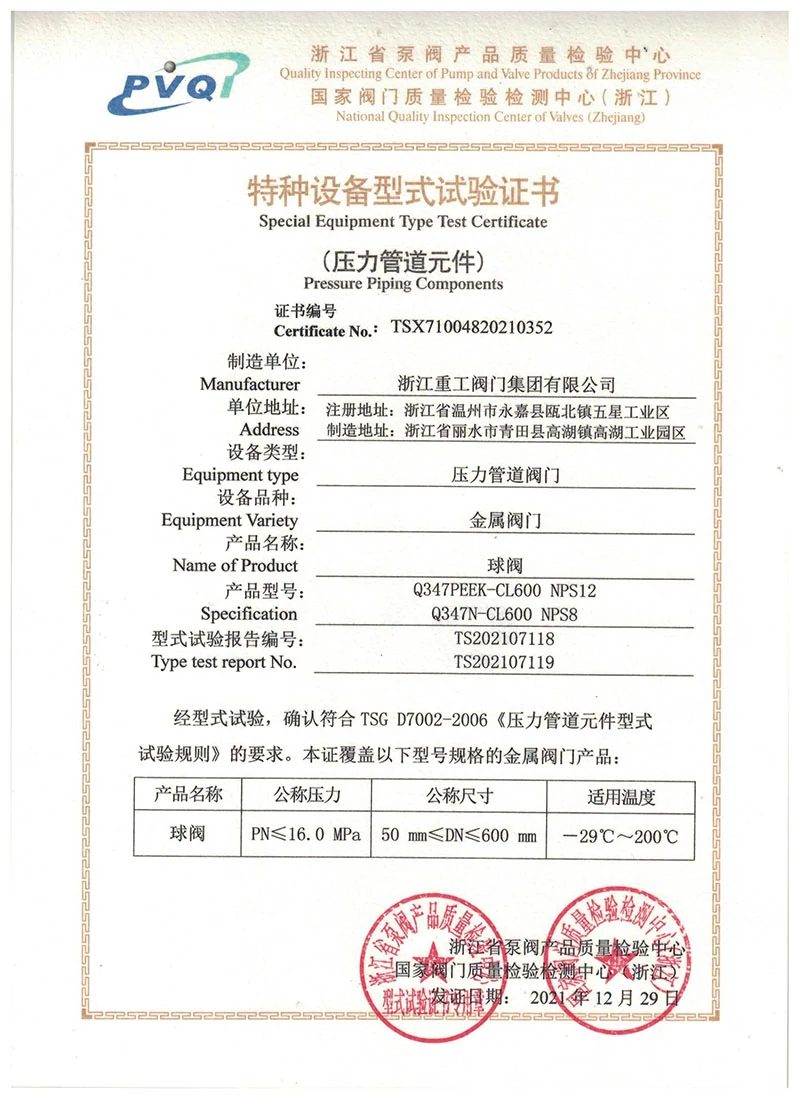
Swipe horizontally to see all columns.
| Certificate field | Published information | Use in the enquiry |
|---|---|---|
| Certificate number | TSX71004820210352 | Identify the document being requested |
| Manufacturer | Zhejiang Zhonggong Valve Group Co., Ltd. | Match the manufacturer named in the offer |
| Listed specifications | Q347PEEK-CL600 NPS12 and Q347N-CL600 NPS8 | Check the connection between the tested and offered configurations |
| Type-test report numbers | TS202107118 and TS202107119 | Identify supporting reports required by the project |
| Issue date | 29 December 2021 | Review against current document requirements |
Source: ZGV's published scan, reviewed on 16 October 2026. Applicability depends on the complete certificate and supporting records. Current status has not been independently checked against an issuing-body register for this guide.
The Q347 specifications on the scan are different identifiers from website references 2511, 2512, 2514 and 2515. The supplier needs to show how the offered engineering model and configuration fall within the relevant document's coverage. Shared use of the term ball valve is insufficient. Requirements for fire testing, emissions or EU conformity need their own applicable evidence.
The purchase specification should also settle the design standard and edition, the complete valve's pressure-temperature rating and the inspection and test plan with acceptance criteria. Material traceability and witnessing need to be included where required. ASME B16.34 and ASME B16.10 address different parts of valve specification; citing them is not evidence that a particular offered valve has been certified.
Actuators and the complete valve assembly
The choice between a lever, gearbox, pneumatic actuator and electric actuator changes both the quotation and the space required. An automated package also needs a defined response to loss of power, air supply and control signal. Those are separate conditions, and double-acting construction alone does not establish the failure position.
For a pneumatic package, the available minimum and maximum air pressures form part of the sizing basis. Torque through the stroke, any spring stroke, the selection margin and maximum allowable stem torque belong in the supplier's review. A torque figure without its operating conditions is an incomplete basis for choosing an actuator.
Travel time, feedback, solenoids and manual override should reflect the intended operating sequence. Environmental requirements and accessory dimensions then complete the assembly review. These details belong in the initial enquiry so that bidders price the same package.
Performance and commercial data for the offered configuration
The four product pages provide materials, sizes, dimensions and weights. They do not publish numerical Cv or Kv, valve torque or complete pressure-temperature rating curves for the configurations compared here. Those figures need to be supplied for the offered size, bore, materials and operating conditions before they can support a performance comparison.
Current unit price, minimum order quantity and delivery lead time also need a quotation. A useful reply identifies the configuration and quantity behind the price, and states when the delivery period begins. Catalogue dimensions cannot establish commercial availability.
The RFQ and quotation comparison
The editable Excel RFQ template contains 48 requirement fields and a separate comparison sheet for three suppliers. Buyer requirements sit alongside the proposed configuration and evidence, so a difference can be reviewed without losing the original requirement.
Swipe horizontally to see all columns.
| Requirement group | Buyer provides | Supplier returns |
|---|---|---|
| Identification and duty | Project, tag, quantity, function and service cases | Proposed construction and engineering model |
| Operating data | Fluid, pressure, temperature, flow and differential pressure with units | Application limits, assumptions and sizing data |
| Mechanical specification | Size, class, bore, connections, materials and space constraints | Component schedule and dimensional drawing |
| Operation | Operator, utilities, failure action, timing and feedback | Sizing basis, accessories and assembly drawing |
| Inspection and documents | Standards, editions, acceptance criteria and witnessing | Included records, inspection plan and applicable certificates |
| Delivery and commercial scope | Required date, delivery term and named place | Schedule, exclusions, warranty, validity and itemised pricing |
Supplier replies use Complies, Deviates or Needs clarification. Unanswered requirements remain Open, with a named owner for follow-up. An alternative needs its effect on fit, duty and cost explained before acceptance. The worksheet records the decision; engineering approval remains a separate responsibility.
A price comparison becomes meaningful once the offers cover the same configuration and inspection scope. A lever-operated valve with standard inspection and a gear-operated valve with extra witnessing are different purchases. Those differences need to be priced against the project requirement before either total becomes a basis for purchase.
Its purchase subtotal adds four charges: valve and operator, inspection and documents, packing, and agreed transport. All four must contain numbers before a subtotal appears. Zero means a confirmed absence of charge; a blank means the amount is still unknown. Taxes and duties are excluded from that subtotal. Offers still need a common currency and delivery basis.
Drawing approval, production, inspection release and dispatch are separate schedule milestones. Technical deviations should be settled before manufacture or substitution. Claims about lifecycle savings need operating and maintenance assumptions supported by data before they enter the purchasing decision.
Common procurement questions
Can an enquiry start without a model number
Yes. The duty and operating data can be the starting point. A preliminary enquiry should identify the fluid, function, size, pressure, temperature, connection and quantity, with missing inputs marked Pending. The supplier can then propose a construction against stated requirements.
What if a certificate names a different model
The difference needs an explanation supported by the complete document and its coverage. The supplier should connect the offered model, size, materials and configuration to that evidence. The applicability question stays open until the project accepts the supporting records.
Can a price be requested while some data is missing
A budget quotation can proceed with written assumptions and exclusions. It remains provisional while technical requirements or charges are unresolved. Keeping those gaps visible makes a later firm quotation easier to compare.
Sending a valve enquiry to ZGV
A completed RFQ, the available project datasheet and a drawing give ZGV a defined starting point for a quotation. The contact page provides the enquiry form and business email. Completed workbooks and supporting files can be shared through the published email; the current form has no upload field.
The supplier's reply should link its price to the proposed engineering model, material schedule, operator and dimensional drawing. Deviations and exclusions belong alongside that offer. ZGV's manufacturing page describes material control, machining, assembly, testing and delivery. Required project records and their delivery dates should be agreed in the quotation.