ZGV / BALL VALVE DESIGN
Floating vs Trunnion Ball Valve: Design and Selection Guide
Two ball valves can have the same nominal size and pressure class yet need different operating torque and sealing arrangements. The difference starts with how the ball is supported. If you are comparing a floating ball valve with a trunnion-mounted ball valve, start with the ball-support construction, then check the complete service specification.
The difference, in brief
In a floating ball valve, the ball can move slightly under line pressure and load the downstream seat. In a trunnion-mounted design, mechanical supports restrain the ball; sealing depends on the specified seat arrangement. Choose between them using the actual differential pressure, size, materials, seat design and operating requirements. There is no universal pressure-class cutoff that decides the choice.
Floating vs trunnion ball valve: comparison
| What to compare | Floating ball valve | Trunnion-mounted ball valve |
|---|---|---|
| Ball support | The ball has limited movement and is supported by the seats. | The ball is mechanically supported by trunnions or bearings. |
| Seat loading | Pressure can move the ball toward the downstream seat. | Seat mechanisms provide the specified sealing action against the supported ball. |
| Operating torque | Evaluate torque at the specified differential pressure and temperature. | Support can reduce pressure-related ball loading; obtain the actual valve torque data. |
| Pressure class | Confirm the offered material and complete pressure–temperature rating. | Confirm the offered material and complete pressure–temperature rating. |
| Bore and body access | Full/reduced bore and side/top entry are separate specification choices. | Full/reduced bore and side/top entry are separate specification choices. |
| Decision evidence | Selected drawing, seat arrangement, rating and operating data. | Selected drawing, seat arrangement, rating and operating data. |
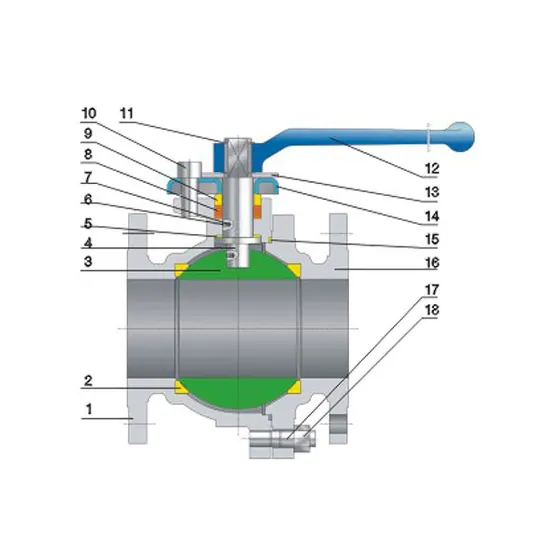
How a floating ball valve works
The stem rotates a bored ball to open or close the passage. “Floating” does not mean the ball is loose: its movement is limited by the design. In the closed position, pressure acting on the ball can push it toward the downstream seat, helping establish the seal. The resulting seat contact also affects the effort needed to turn the ball.
ZGV’s API valve catalogue illustrates this principle in its ball-valve section. The published two-piece floating ball valve, product 2511, is listed for Class 150/300. Its product page is a useful reference when starting an enquiry; the final size, seat, materials, connections and limits still belong to the selected configuration.
References: ZGV API valve catalogue — original ball-valve excerpt, physical PDF pages 2–4 · ZGV product 2511 — two-piece floating ball valve, Class 150/300
How a trunnion-mounted ball valve differs
A trunnion-mounted design supports the ball mechanically, rather than allowing it to move into the seat in the same way as a floating ball. A typical design uses movable, spring-loaded or pressure-energized seats. The exact seat arrangement determines how the valve seals and handles cavity pressure.
Manufacturer technical literature explains that trunnion support can reduce operating torque associated with line-pressure forces. That is a design advantage to investigate, not a promise that every trunnion valve will need less torque than every floating valve. Compare equivalent sizes and duties, then obtain the supplier’s torque data for the offered assembly.
References: Valmet / Jamesbury B100-0EN — floating and trunnion seat-design principles · Valmet — Neles modular trunnion-mounted ball valve, series X
Pressure class alone cannot select the design
Do not turn “floating for low pressure, trunnion for high pressure” into a fixed purchasing rule. ZGV also publishes a two-piece floating ball valve as product 2512, listed for Class 600/900. That catalogue reference demonstrates why a pressure-class label alone cannot determine the ball-support design. It does not establish suitability for your particular operating temperature or fluid.
Class 150, 300 or 600 is a rating designation. Check the applicable pressure–temperature rating for the actual material, together with the seat, seals, end connections and project specification. ASME B16.34’s official scope includes pressure–temperature ratings, materials, dimensions, examination, testing and marking.
Distinguish line pressure from differential pressure across a closed valve. For example, a buyer may describe a 40 bar line while leaving the downstream condition unspecified. A downstream pressure of 39 bar and one of 0 bar create different pressure differences. This arithmetic example is not an operating limit for either ZGV product. State the expected opening and closing conditions when requesting torque or actuator sizing.
References: ZGV product 2512 — two-piece floating ball valve, Class 600/900 · ASME B16.34 — official standard scope
Keep ball support, bore, body and seat as separate choices
A floating ball valve is not automatically reduced bore. A trunnion ball valve is not automatically full bore. Manufacturer catalogues offer both full and reduced bore constructions, and a bore requirement should be checked against the actual internal diameter and project needs.
Likewise, “two-piece” describes body construction, while “top entry” describes access to the internals. Neither phrase alone defines ball support or seat material. ZGV’s catalogue includes a top-entry floating-ball example. Specify each feature independently so a quotation does not silently substitute one assumption for another.
Soft and metal seats are another separate choice. Ask for the relevant fluid and temperature compatibility, leakage acceptance criteria, operating limitations and required test documents. A generic design name does not establish fire-test qualification, emissions performance or current certification for the configuration on offer.
References: Emerson — ball-valve categories and full/reduced bore options · Valmet / Jamesbury product training — separate design characteristics · ZGV API valve catalogue — original ball-valve excerpt, physical PDF pages 2–4
Which design should you put in the RFQ?
Start with a floating-ball option when an existing approved specification or product reference already calls for that construction, then check whether the offered valve meets the complete duty. Evaluate a trunnion-supported option when ball loading, operating effort or the specified seat arrangement becomes a key selection concern. Avoid selecting solely from a catalogue photograph or a nominal-size rule.
For an actuated valve, request the valve’s breakaway, running and closing torque under the stated service conditions, plus the proposed actuator sizing basis. Provide available air or power, operating frequency and the required position following loss of supply. Treat the valve and actuator as an assembly to be reviewed.
If the line can trap fluid between seats, ask how the offered arrangement handles cavity pressure and what the project requires. Double block and bleed, bidirectional sealing and cavity relief are configuration-specific features. Confirm them from the selected design and required test documentation rather than inferring them from “trunnion”.
References: Emerson / Fisher V280 — standard single-seal and optional dual-seal construction · Valmet — control-valve package selection and sizing fundamentals
Compare the complete quotations, not only the unit price
Create one comparison sheet for all offers. Check the ball-support design, size, class, pressure–temperature limits, body and trim materials, seat and packing, bore, connection, face-to-face length, operation and required documents. Ask each supplier to identify deviations explicitly.
Keep the drawing revision and product reference on the enquiry. Product 2511 and product 2512 identify two published ZGV floating-ball references; they do not make all their dimensions or options interchangeable. Request the current agreed drawing and configuration before placing an order.
When a detail is unknown, mark it for confirmation instead of filling in a plausible value. That makes the technical discussion useful and keeps the final choice connected to your actual service conditions.
References: ZGV product 2511 — two-piece floating ball valve, Class 150/300 · ZGV product 2512 — two-piece floating ball valve, Class 600/900
Ball valve RFQ checklist
Use one set of service conditions when comparing floating and trunnion options.
- Reference and quantity
- Product 2511 or another agreed product/drawing reference, required size and quantity.
- Fluid and duty
- Fluid composition, solids if present, isolation or control duty, and operating frequency.
- Pressure and temperature
- Operating and design values, upstream/downstream conditions and maximum differential pressure during operation.
- Construction
- Floating or trunnion support, required bore, body access, connections and installation dimensions.
- Materials and seats
- Body, ball/trim, stem, seat, packing and seal requirements; identify any alternatives.
- Operation
- Lever, gearbox or actuator; available supply, required fail position and torque/sizing documentation.
- Verification
- Project standards and editions, leakage criteria, required current certificates, inspection and test documents.
Frequently asked questions
Is a trunnion ball valve always better than a floating ball valve?
No. The appropriate design depends on the specified duty, dimensions, seats, pressure–temperature limits and operating requirements. Compare the complete offered configurations.
Can a floating ball valve be used in a higher pressure class?
A pressure-class number does not define ball support. ZGV’s published product 2512 is a floating-ball reference listed for Class 600/900. Suitability still needs confirmation for the actual materials, temperature and complete configuration.
Does trunnion mounting guarantee double block and bleed?
No. Confirm the seat arrangement, specified isolation function and applicable test documentation for the offered design.
Does a two-piece body mean the valve has a floating ball?
No. Body construction and ball support are separate characteristics. Specify both rather than inferring one from the other.
What is the most useful starting point for a ZGV floating ball valve enquiry?
Use product 2511 for the published Class 150/300 reference, then send your fluid, size, operating and design pressure and temperature, differential pressure, materials, connection, operation and quantity.
Sources and scope
ZGV product statements are limited to the cited catalogue and published entries. Other manufacturers’ technical references explain design principles; their product approvals and performance claims are not ZGV certifications. Confirm the final configuration, current agreed drawing and project requirements with the quotation.
- ZGV API valve catalogue — original ball-valve excerpt, physical PDF pages 2–4
- ZGV product 2511 — two-piece floating ball valve, Class 150/300
- ZGV product 2512 — two-piece floating ball valve, Class 600/900
- Valmet / Jamesbury B100-0EN — floating and trunnion seat-design principles
- Valmet — Neles modular trunnion-mounted ball valve, series X
- ASME B16.34 — official standard scope
- Emerson — ball-valve categories and full/reduced bore options
- Emerson / Fisher V280 — standard single-seal and optional dual-seal construction
- Valmet / Jamesbury product training — separate design characteristics
- Valmet — control-valve package selection and sizing fundamentals