
Stating the flow direction gives a vertical check-valve enquiry a clear starting point. Upward and downward flow create different opening and closing questions, particularly where gravity contributes to movement.
A check valve's permitted orientation depends on its actual mechanism and manufacturer's instructions. State upward or downward flow, then verify opening, stable operation, closing response and movement clearance for the offered design.
ZGV's swing, forged lift and compact check-valve references help buyers start with the mechanism that fits their installation question. State the flow direction and operating range so the technical enquiry can address mounting, stable operation and the space needed for movement and maintenance.
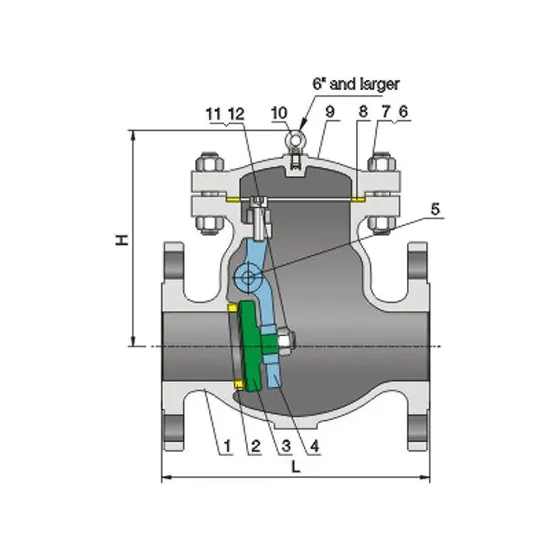
Name the direction, not just the pipe position
Mark the intended flow arrow on the installation sketch. Identify whether the line is horizontal, vertical-up or vertical-down and how a hinge, guide or spring is oriented. The broad family name is insufficient where the mechanism depends on gravity or a prescribed mounting position.
A spring does not automatically remove every orientation restriction. It can influence closure force, while the complete mechanism, fluid and required opening conditions still need review. Use the actual model's instructions rather than advice for another spring-assisted check valve.
Spirax Sarco's check-valve tutorial explains how different designs operate. Its design-specific examples should not be expanded into a statement that every lift, swing or compact check can be installed the same way.
Why the mechanism changes the orientation answer
Forward pressure must move the closure away from its seat; gravity, springs and reverse pressure influence the return. Reorienting the assembly changes how gravity acts along that movement. A hinge and a guided lift element therefore cannot be given the same blanket vertical-installation answer.
The Spirax Sarco design explanations describe different moving elements and closing arrangements. Use them to identify the mechanism to ask about, then follow the exact model's mounting approval. In particular, an upward-flow approval leaves downward flow as a separate case to confirm.
Separate opening pressure from stable flow
A valve can begin to open without reaching a stable operating position. Minimum operating flow therefore matters alongside the initial opening requirement. In a variable-flow or multiple-pump system, the lowest sustained flow can be more revealing than the maximum design point.
| Operating case | What to ask about |
|---|---|
| First opening | Required differential pressure under the selected orientation |
| Lowest sustained flow | Stability and any minimum operating requirement |
| Normal/maximum flow | Configuration-specific pressure loss and permitted operating range |
| Normal stop | Closing behaviour under the intended sequence |
| Power failure or rapid reversal | Relevant dynamic response and system transient assessment |
The final row is a separate analysis. An orientation approval or a low opening pressure is not a non-slam guarantee.
An illustrative flow-range question
Suppose a hypothetical line operates at 12, 30 and 45 m³/h in different pump combinations. A supplier provides a pressure-loss point at 45 m³/h but no information at 12 m³/h.
The offer supports a maximum-flow comparison, but minimum-flow stability remains open. Ask whether the proposed closure element operates acceptably at 12 m³/h in the actual orientation, and obtain the relevant evidence. Do not invent a safe minimum velocity from the nominal pipe size.
If a different valve size is proposed, review the transitions, loss and complete operating range. Matching the pipeline diameter can be convenient, but it does not replace the valve's operating assessment.
Use ZGV's references to identify the construction
ZGV lists a flanged swing check valve 2553, forged lift check valve 2561 and compact check entry 2563. These are distinct starting points for a technical enquiry.
Use the product drawings to identify the construction, then ask ZGV for the exact engineering model, closure arrangement, spring where applicable and permitted orientations. Confirm vertical-downflow and minimum-flow requirements for that selected build. If the supplier proposes another construction, have it explain the effect on the specified duty and layout.
The pump-discharge selection guide treats closing response during pump trips. Use that analysis when the system has a significant transient; keep it separate from the orientation check in this article.
Inspect the moving envelope
Compact and wafer constructions can place moving parts close to adjacent pipe or equipment. Confirm the full travel clearance against actual pipe inside diameter, liners, gaskets, reducers and adjoining components.
For a full-bodied swing design, cover removal and access to internals may dominate maintenance space. A short catalogue length alone says little about that removal envelope. Mark the necessary access on the installation drawing before the support layout is fixed.
Describe solids, deposits and pulsation. A mechanism that operates well in a clean steady flow may need a different assessment for debris or repeated pressure pulses. Those are reasons for a configuration-specific review, not automatic recommendations to add or remove a spring.
Backflow prevention is not every pressure problem
TLV's check-valve installation explanation makes a useful distinction in condensate systems: blocking reverse flow does not eliminate back pressure or guarantee discharge into a higher-pressure return line. A check valve should therefore not be purchased as a universal cure for poor drainage or all water hammer.
A check valve also does not replace the maintenance isolation arrangements required by the facility. Establish the purpose of the component and the site isolation philosophy separately.
Prepare an orientation-specific enquiry
Send the fluid, pressure/temperature range, minimum/normal/maximum flow, pipe sketch, intended direction and stop/trip conditions. Request the permitted orientation, flow-loss basis, stable-operation limits, movement clearance and relevant response information.
Keep cracking/opening pressure and minimum stable flow as different fields with their own units. A low opening-pressure value is not a numerical substitute for a stable-flow requirement. If the supplier has only one of those data items, record exactly which question it answers.
Submit the direction and operating range with the chosen check-valve reference. A clear reply should approve the actual vertical-up or vertical-down case rather than repeat an undefined vertical-installation label.
ZGV VALVE · Zhejiang Zhonggong Valve Group Co., Ltd. · Quality and certification records
Download the ZGV valve RFQ template and share your service conditions, quantities and required documents with ZGV.