
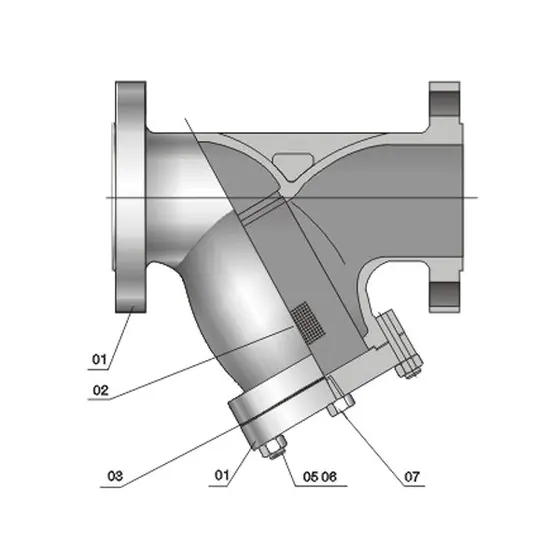
A good Y-strainer enquiry identifies the opening and available screen area behind the mesh label. Two 20-mesh screens can use different wire diameters, so actual aperture and open area help buyers compare their proposed elements.
Specify actual aperture, wire or perforation geometry, material, effective open area, clean/dirty pressure loss and permitted differential pressure. A strainer protects equipment by retaining debris; it does not replace a shutoff valve or a maintenance isolation arrangement.
ZGV's Y-type filter and strainer references bring the body and screen into the same procurement discussion. Use the actual aperture, flow range, debris and maintenance access requirements to request the appropriate element and a clearly defined hydraulic and document scope.
Mesh count is not a fixed micrometre opening
For an ideal square woven screen, a useful geometry relationship is:
Pitch in mm = 25.4 ÷ mesh count per inch
Clear aperture = pitch − wire diameter
Ideal open-area fraction = (clear aperture ÷ pitch)²
These relationships assume a regular square weave. Actual screen construction, seams, supporting plate and manufacturing tolerances affect the usable result. They are not a manufacturer flow coefficient or a pressure-loss calculation.
Consider two hypothetical 20-mesh screens:
| Assumed geometry | Screen A | Screen B |
|---|---|---|
| Mesh count per inch | 20 | 20 |
| Pitch | 1.27 mm | 1.27 mm |
| Wire diameter | 0.40 mm | 0.50 mm |
| Calculated clear aperture | 0.87 mm | 0.77 mm |
| Ideal open area | 46.9% | 36.8% |
The calculated apertures are 870 micrometres (0.87 mm) and 770 micrometres (0.77 mm). The mesh count matches, while the geometric openings and open areas differ. Neither screen is approved for a duty by this example. The buyer still needs debris-retention, strength and hydraulic information for the actual element.
Spirax Sarco's strainer tutorial distinguishes perforated and woven screens and explains selection and maintenance considerations. Use the chosen supplier's actual element data for purchase.
Start with the debris and the protected equipment
Describe what the strainer must retain: welding debris, scale, rust flakes, fibres or another identified contaminant. The downstream equipment's required protection helps define the aperture. A finer screen is not automatically an improvement if it creates unacceptable blockage or loss.
Include fluid composition, temperature, flow range, viscosity where relevant, and expected debris loading. A start-up debris load may differ substantially from normal service. If a temporary start-up screen is required, identify how its removal or replacement will be controlled.
A strainer does not make an incompatible valve material suitable for the process. It also does not guarantee removal of all fine particles or dissolved contaminants. Define the protection task before selecting a mesh.
Compare effective area and pressure loss separately
The ratio of effective open screen area to pipe area can help describe the proposed element. It does not independently predict the complete strainer's pressure loss. Body geometry, screen support, fluid properties and accumulated debris also matter.
Request clean-element loss at the required flow points and a design basis for the permitted dirty condition. Identify the maximum allowable differential pressure for the actual element and any required alarm or maintenance trigger. Those values need to come from the selected design and approved system requirements.
| Condition | Evidence to request |
|---|---|
| Clean element | Pressure loss at minimum/normal/maximum flow as relevant |
| Debris accumulation | Maintenance/alarm basis and effect on available pressure |
| Maximum permitted differential | Element strength limit and relevant conditions |
| Startup screen | Expected scope, monitoring and removal/replacement plan |
| Suction-side service | System review of available inlet pressure and added restriction |
Do not use normal line pressure as the element's allowable differential pressure. Pressure on both sides and the difference across the screen are different mechanical questions.
Read a differential-pressure observation correctly
As a hypothetical arithmetic example, an upstream reading of 12.0 bar gauge and downstream reading of 11.8 bar gauge gives a difference of 0.2 bar. At 12.0 and 11.2 bar gauge, it is 0.8 bar. Compare readings at the same relevant flow and fluid condition before interpreting the change as element loading.
Neither 0.2 nor 0.8 bar is a cleaning trigger or strength limit for a ZGV element. Those limits come from the selected element and approved maintenance basis. The example separates the measurement to trend from the line pressure and from the manufacturer's allowable differential.
Plan to remove the screen safely
A Y-strainer may fit between connections while its cover and screen cannot be withdrawn. Ask for the removal envelope and check access against insulation, supports and adjacent equipment.
The installation orientation also matters. TLV's steam-accessory discussion explains that some shapes can collect condensate. The correct orientation should follow the selected product and fluid service, rather than one illustration copied into every liquid, gas and steam installation.
Cleaning, opening a cover or operating a blowdown arrangement requires the facility's approved isolation and depressurisation provisions. The presence of a drain connection is not permission to remove a cover under pressure.
How to identify a ZGV strainer enquiry
ZGV lists Y-type filter 2495, Y-shaped filter 2496 and Y-type strainer 2578. Use these catalogue references to identify the body and connection arrangement, then specify the required screen grade, aperture, allowable differential pressure and flow-loss information for the offer.
Request the exact body and element build, connection and rating basis, actual aperture and supporting screen, hydraulic data and maintenance drawing. If a standard element is proposed, ask whether it meets the protected equipment's requirement. Keep any finer or stronger alternative visible in the quotation.
Open area describes available geometry, not a guaranteed particle-removal efficiency. Irregular particles, screen construction and loading can affect retention. If a defined filtration performance is required, state the appropriate performance basis separately from the nominal mesh or aperture.
Send the debris, aperture and flow requirements so a quotation can identify a screen and body together. The better comparison is the required protection at an acceptable maintained pressure loss, supported by the actual element's limits.
ZGV VALVE · Zhejiang Zhonggong Valve Group Co., Ltd. · Quality and certification records
Download the ZGV valve RFQ template and share your service conditions, quantities and required documents with ZGV.