
An end-of-line requirement is best included in the valve enquiry from the start. If downstream pipework will be removed while pressure remains on the other side, describe that arrangement so the manufacturer can address the correct assembly and service condition.
Lug construction alone does not establish a dead-end or end-of-line rating. Obtain written approval for the exact size, design, direction, pressure-temperature conditions and hardware with the downstream flange absent.
ZGV's concentric, double-eccentric and triple-eccentric butterfly-valve ranges give buyers several constructions to discuss for a defined duty. An end-of-line enquiry can then focus on the selected size, seat arrangement, pressure direction and hardware needed for that installation.
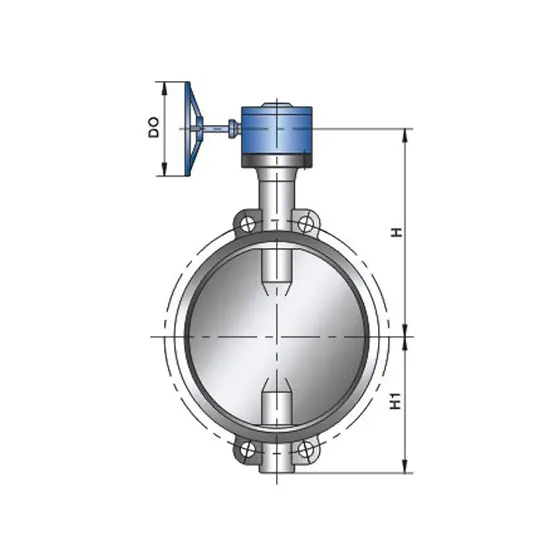
Describe the maintenance condition explicitly
An ordinary line-service drawing usually shows both mating flanges. If downstream equipment is removed, the remaining joint and valve body see a different arrangement. The bolt engagement, load path and support can change, while the disc may become exposed.
State what will actually be removed and what remains. Identify the retained-pressure side, possible reverse pressure, service temperature, required shutoff and any protective or isolation arrangements. Do not assume that a convenient access opening makes a pressurised installation safe for personnel.
The facility's maintenance isolation and work-control requirements remain separate. A manufacturer's end-of-line rating is a design input, not blanket permission to open downstream equipment or work beside an exposed pressurised disc.
Distinguish connection style from approved service
A wafer body is typically retained by the surrounding flange assembly. A lug body provides a different bolting arrangement. A double-flanged body provides another arrangement. The name is useful for describing hardware, but actual service limits come from the selected design and approval.
ZGV's 2564 concentric, 2566 double eccentric and 2567 triple eccentric entries show different sealing constructions and publish wafer/lug data. Use their published sealing construction, dimensions and connection information to identify a candidate, then request its end-of-line pressure, direction and hardware confirmation.
| Requirement | What the offered drawing/confirmation should show |
|---|---|
| Retained pressure | Approved pressure-temperature condition without downstream flange |
| Direction | Which side can remain pressurised and any reverse-pressure restriction |
| Hardware | Lug/thread details, approved bolts and engagement requirements |
| Mechanical support | Valve and actuator support for the actual removed-pipe condition |
| Disc space | Full travel and any required guarding or adjacent clearances |
| Shutoff | Applicable test basis and required leakage acceptance |
Record the manufacturer's response against each required condition. Where the proposed assembly differs, agree the revised configuration or engineering disposition before ordering.
Review pressure rating and seat function separately
A valve can have adequate body pressure capability while its seat arrangement has direction-specific limits. End-of-line approval can also differ from the normal line-service rating. The quotation should identify those limits clearly rather than repeat only the catalogue class.
The butterfly selection guide distinguishes geometry, seal and connection. For the present task, take the next step: evaluate the exact assembly when one mating side is removed.
Bray's Series 20/21 manufacturer page explicitly distinguishes its wafer Series 20 from the lug Series 21 with dead-end capability. This is the kind of design-specific statement to look for. Its pressure and service scope belong to Bray's stated configuration; obtain ZGV's separate confirmation for the proposed valve.
A fictional offer that needs clarification
Imagine a fictional enquiry for a lug butterfly valve upstream of removable equipment. The response states “Class 150, bidirectional, lug body.” Those words identify useful features, but the buyer still needs answers about the removed-flange condition.
Ask the supplier to return a marked drawing showing the retained side and missing downstream flange. Request the exact allowable condition and hardware, then compare them with the project requirement. If the answer uses the standard two-flange installation, it has not addressed the enquiry's maintenance case.
Also resolve what the bidirectional statement describes. It may concern normal line shutoff rather than every possible direction in an unsupported end-of-line arrangement. The approval needs to cover the condition actually being purchased.
Check the disc and the operator
The rotating disc needs clearance through its entire travel. A nearby reducer, lining, gasket or equipment inlet can interfere even if the closed valve fits. Ask for the required bore/clearance drawing and check the real adjacent components.
The operator adds weight, torque reaction and access requirements. Removing downstream pipework can change the support situation. A powered package also needs defined action and access controls so an unexpected movement is addressed by the site's engineered safeguards.
Do not use catalogue weight as a lifting instruction, and do not assume an actuator bracket supports the whole assembly. Handling, support and permitted lifting points belong in the manufacturer's supplied instructions and site plan.
Make the quotation conditional on the actual case
A useful requirement states the selected size, service, end pattern, upstream/downstream pressure-temperature conditions and what will be absent during maintenance. It requests the manufacturer-approved configuration, hardware, limits, drawing and applicable test evidence, with deviations listed explicitly.
Have the confirmation identify the exact drawing revision and maintenance configuration. If support, bolting or retained-pressure direction changes, return that change for review. The original approval should not be carried forward merely because the replacement is still called a lug butterfly valve.
Send the end-of-line arrangement and required retained pressure with the product reference. Obtain the exact approval before treating a lug valve as a suitable maintenance boundary.
ZGV VALVE · Zhejiang Zhonggong Valve Group Co., Ltd. · Quality and certification records
Download the ZGV valve RFQ template and share your service conditions, quantities and required documents with ZGV.