
A quotation marked “triple offset, metal seated, lug type” answers three different specification questions: how the disc moves, how it seals, and how the body connects to the line. Keeping those questions separate makes an alternative offer easier to evaluate.
For procurement, start with the duty, then select those three elements together. A triple offset valve is not automatically the best purchase for every line, and a concentric design is not automatically inadequate because its geometry is simpler.
What the offsets change
In a concentric butterfly valve, the shaft, disc and seat are centred. A double offset design moves the shaft relative to both the sealing plane and the body centreline, changing how the disc leaves the seat. A triple offset design tilts the axis of the sealing cone relative to the pipe centreline. The practical concern is how contact is made and released, rather than the number of offsets considered in isolation. Emerson butterfly valve guide, December 2025, pages 2–6
Those geometries lead to different sealing and operating arrangements, but the catalogue name is still incomplete. Ask which seat material, seal-ring construction, flow direction and closing torque apply to the offered design. The combination determines what can actually be evaluated for the service.
The ZGV catalogue illustrates multiple sealing arrangements within butterfly valve families. That is a useful reminder that an offset label does not specify every part touching the fluid. ZGV butterfly valve catalogue excerpt, printed pages 078–083
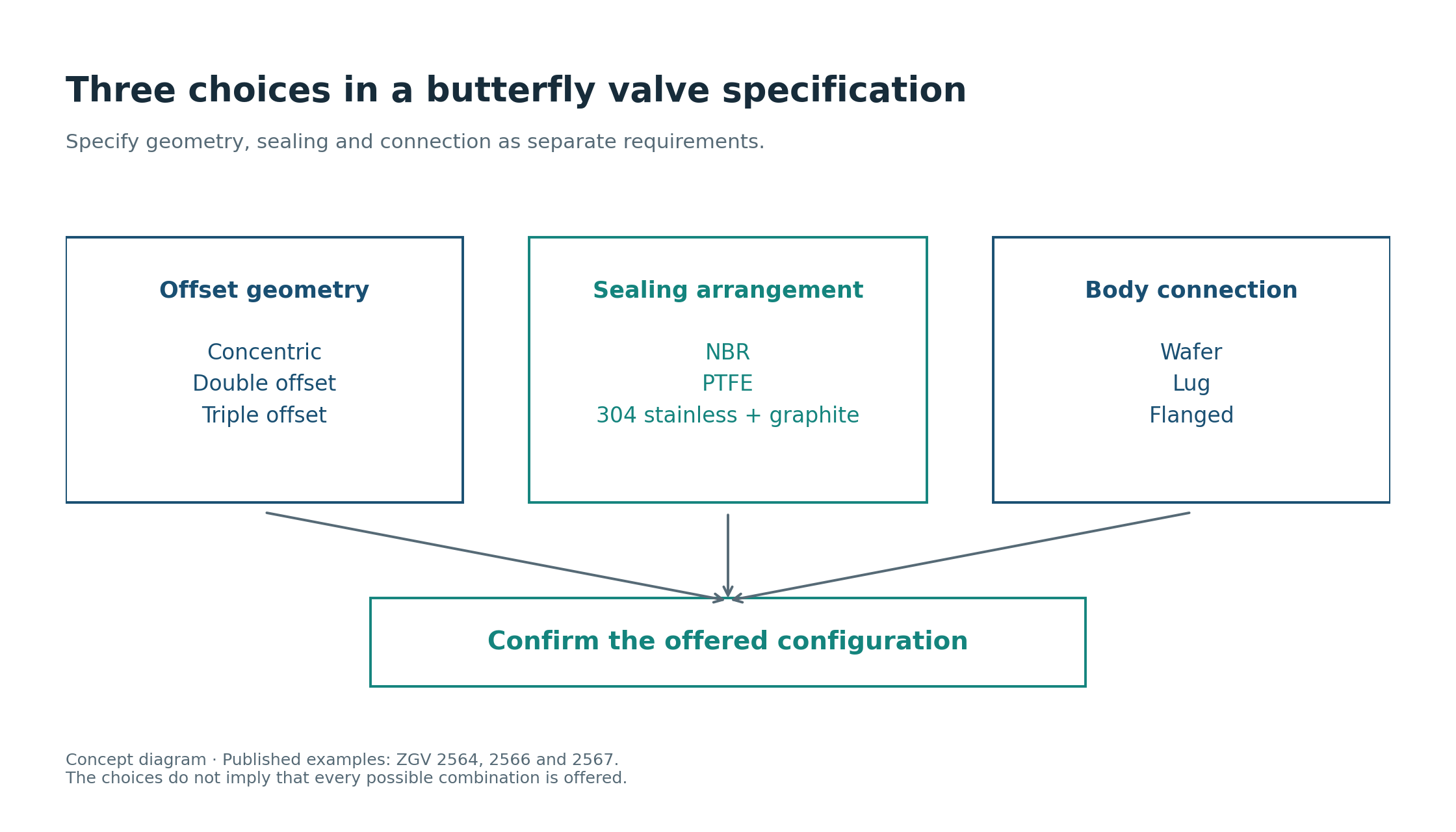
Swipe or scroll horizontally to see the full diagram.
Compare real material combinations
The following published ZGV configurations show how geometry and materials are paired in particular products.
| Catalogue configuration | Published seat or sealing element | Selected accompanying parts |
|---|---|---|
| Concentric rubber seated Class 150 | NBR seat | WCB disc; A276 410 stem; NBR O-ring |
| Double eccentric Class 150 | PTFE seat | WCB disc; A276 410 stem; PTFE packing |
| Triple eccentric metal seated Class 150 | 304 stainless + graphite seal ring | WCB disc; A182 F304 stem; flexible graphite packing |
Scroll the table horizontally on a small screen.
Sources: concentric product 2564, double eccentric product 2566 and triple eccentric product 2567. These entries describe catalogue configurations, not a statement that their complete operating envelopes are interchangeable.
Two details matter when reading the table. First, the Class 150 triple eccentric entry has a composite seal-ring description containing graphite. The word “metal” should not be expanded into a claim that every sealing component is solid metal. Second, the disc material alone cannot describe the seat or stem sealing system. A WCB disc appears in all three entries, alongside different sealing materials.
Specify the medium and temperature before accepting any of these combinations. Elastomer compatibility depends on the actual fluid and conditions. The applicable pressure-temperature envelope of the complete valve remains necessary even when a material’s general temperature range seems adequate.
Wafer and lug describe the installation choice
Wafer and lug arrangements can be offered within a butterfly valve family. A short face-to-face length can be attractive in a compact skid, but installation requires more than a matching nominal size.
Check the mating flange standard, flange inside diameter, gasket arrangement and clearances around the disc throughout travel. A disc that rotates into the adjacent pipe or equipment envelope needs enough space to move. A drawing with only the closed position can hide that interference.
Lug construction should also not be treated as automatic proof of a particular end-of-line rating. Where downstream pipework will be removed while the other side remains pressurised, state that duty explicitly and obtain the manufacturer’s confirmation for the exact size, direction and pressure. The connection name does not settle the condition.
These distinctions are especially useful when a supplier proposes a different body style as a cost-saving alternative. The alternative may be acceptable, but it must be reviewed against the installation and maintenance requirement that led to the original choice.
Compare three catalogue sizes
For an initial space and handling comparison, the three Class 150 entries above publish these dimensions and weights.
| Class 150 configuration | Size | Listed L mm | Wafer weight kg | Lug weight kg |
|---|---|---|---|---|
| Concentric rubber seated | NPS 4 | 52 | 12 | 15 |
| Double eccentric PTFE seated | NPS 4 | 54 | 13 | 16 |
| Triple eccentric metal seated | NPS 4 | 54 | 13 | 16 |
| Concentric rubber seated | NPS 6 | 56 | 16 | 19 |
| Double eccentric PTFE seated | NPS 6 | 57 | 26 | 28 |
| Triple eccentric metal seated | NPS 6 | 57 | 26 | 28 |
| Concentric rubber seated | NPS 8 | 60 | 20 | 24 |
| Double eccentric PTFE seated | NPS 8 | 64 | 36 | 43 |
| Triple eccentric metal seated | NPS 8 | 64 | 36 | 43 |
Scroll the table horizontally on a small screen.
Sources: the dimension tables for 2564, 2566 and 2567. Confirm the selected connection drawing and the scope included in the stated weights. These figures do not include a verified complete actuator assembly.
At NPS 8, the concentric wafer entry is 4 mm shorter and 16 kg lighter than the double eccentric wafer entry in this extract. The double and triple eccentric entries, meanwhile, publish the same L and weight values at all three displayed sizes. These are installation and handling differences. Torque, leakage and service life need their own configuration-specific evidence, while installed cost also includes the operator, supports and access arrangements.
The pressure class must remain part of the comparison. The separate ZGV Class 300 triple eccentric table lists an NPS 6 L of 59 mm, wafer weight 29 kg and lug weight 33 kg. Those values should not be replaced by the Class 150 figures because the product family name is similar. Class 300 product 2568
On/off service and continuous control ask different questions
For on/off duty, the initial checks include whether the valve can open and close at the specified differential pressure, attain the required shutoff and deliver the agreed failure action when automated. A long idle period followed by a demanded movement may be relevant to the torque basis.
For continuous control, ask for more. The useful operating range, flow characteristic, fluid forces, drive-train behaviour, actuator resolution and positioner arrangement need to support the control task. Adding a positioner to an offered on/off package does not establish how precisely it will regulate the process.
The distinction affects what data belongs in the offer. A drawing and a single maximum torque number may be enough to begin an isolation-valve discussion, but they do not describe installed control performance. A credible control proposal should identify the flow and pressure conditions at minimum, normal and maximum demand and explain the usable travel range.
Avoid copying a recommended throttling-angle range from an unrelated butterfly valve. Disc geometry and the fluid duty can change the useful range. Obtain the range for the proposed configuration and the sizing calculation behind it.
Use the duty to narrow the shortlist
| Buyer’s main constraint | What should drive the next comparison |
|---|---|
| Clean utility duty within an elastomer’s confirmed envelope | Compatibility, assembly rating, shutoff requirement and economical complete installation |
| A specified PTFE sealing arrangement | Exact seat construction, supporting parts and pressure-temperature limits |
| A proposed metal seated design for a demanding temperature | Complete seal-ring and packing materials, rating and required test evidence |
| Restricted installation space | Connection drawing, rotating disc clearance and full operator envelope |
| Continuous modulation | Configuration-specific sizing, usable travel, dynamic torque and complete control package |
| Downstream maintenance with pressure retained upstream | Explicit confirmation of the proposed end-of-line condition |
Scroll the table horizontally on a small screen.
The fluid description, temperature and pressure difference narrow the shortlist before geometry becomes a deciding factor. For an end-of-line duty, connection approval may eliminate an otherwise attractive option; for continuous modulation, the usable control range may decide it. Each constraint should have a corresponding answer in the technical offer.
When enquiring about ZGV’s concentric, double eccentric or triple eccentric entries, send the fluid conditions and installation drawing together. Request the offered sealing arrangement, pressure-temperature limits, direction requirements and operating torque with units and stated conditions. That reply gives procurement a defensible basis for choosing the complete valve.
Send the valve RFQ worksheet with the installation drawing. Identify the sealing arrangement, body connection and isolation or control duty as separate requirements. You can discuss the butterfly valve configuration with ZGV.