
A clear valve material specification makes quotations easier to compare. Review the body, closure, seat and seals together, including any cleaning fluid, so the proposed configuration answers the complete service requirement.
WCB and CF8M identify different cast body materials. Choosing between them starts with corrosion, temperature and the governing piping specification; it ends with an identified body, trim, seals and bolting arrangement. Neither label proves compatibility of the whole valve.
ZGV's published floating and trunnion ball-valve material tables give buyers a clear starting point for comparing WCB, CF8M and the complete wetted build. Use the listed configurations to prepare a focused material enquiry, with process and cleaning conditions reviewed together.
What is the difference between WCB and CF8M?
WCB is a cast carbon-steel grade; CF8M is a cast austenitic stainless-steel grade containing chromium, nickel and molybdenum. This changes the alloy family under review, rather than simply changing a surface finish.
| Body description | Material identity | Selection consequence |
|---|---|---|
| ASTM A216 WCB | Carbon-steel casting | Check the permitted process exposure and the project's corrosion/design basis |
| ASTM A351 CF8M | Austenitic stainless-steel casting | Assess the specific corrosion mechanism, temperature and contaminants; stainless does not mean immune to every chemical |
The manufacturer's BFE cast-steel valve material schedule shows separate ASTM A216 WCB and ASTM A351 CF8M body/trim configurations. Foundry Fondinox's CF8M material record identifies the austenitic cast grade and alloying elements. These references help identify the material family; use ZGV's offered build and the project specification to confirm the complete valve.
Start with the parts the fluid actually touches
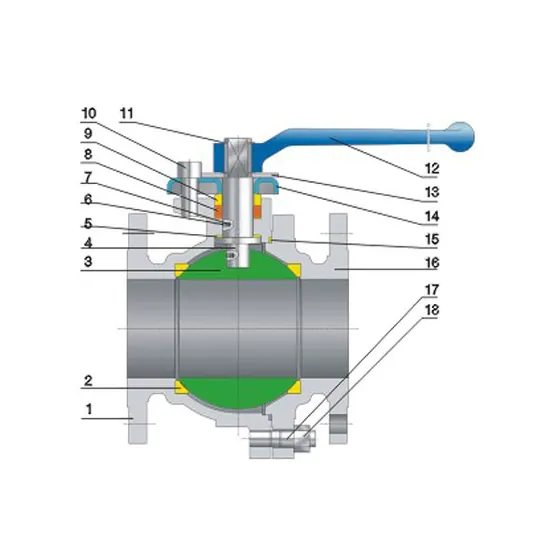
ZGV's 2511 floating ball valve lists an ASTM A216 WCB body, a 304 stainless steel ball, an A182 F6a stem and a PTFE seat seal. Calling that assembly a stainless steel valve because the ball is stainless would conceal the body material.
The 2514 trunnion ball valve publishes separate Standard, Stainless steel and Low-temperature service material columns. The body entries include WCB, CF8M and LCB respectively. Those columns give buyers useful starting configurations. Select a complete offered column and identify any requested change, so the body, trim and seals are assessed together for the named service.
Use one row per component when comparing an offer:
| Component | What to identify | Why a body-only description misses it |
|---|---|---|
| Body and bonnet | Full material specification, grade and relevant condition | Pressure boundary and corrosion exposure |
| Ball, disc, gate or plug | Base material and any defined surface treatment | A stainless closure does not make the body stainless |
| Seat or sleeve | Exact compound or metallic surface system | Chemical compatibility and mechanical limits can differ from the body |
| Stem and bearings | Actual materials and construction | Movement, corrosion and load transfer remain separate concerns |
| Packing and gaskets | Grade, filler or reinforcement where relevant | Cleaning and temperature may govern these parts |
| Bolting | Specified grades and any coating restrictions | External environment and joint design still matter |
A schedule also reveals whether an alternative changes one part or an entire configuration. That makes the engineering decision visible before the commercial comparison.
Define the exposure before choosing the alloy
“Chemical service” leaves the supplier guessing. Supply the fluid name, concentration, impurities, solids and the temperatures at which the valve will operate or stand idle. Include cleaning, flushing and sterilising media if they contact the valve. An intermittent cleaning exposure can be more demanding for a seal than the normal process.
The outside environment matters too. Salt spray, washdown, insulation and trapped moisture can affect components that never contact the process. Internal and external corrosion therefore need separate entries in the review.
Swagelok's materials and corrosion guidance connects material quality, inspection and operating exposure. Its product-specific alloy recommendations concern its own components. The transferable lesson is to investigate the corrosion mechanism and the actual material, rather than assume that the word stainless resolves every exposure.
Match the material shortlist to the service
A project may permit carbon steel for a defined fluid and temperature. Another may require a corrosion-resistant cast alloy. The correct choice follows the piping material class and the service assessment, including the applicable pressure-temperature basis.
CF8M is a cast stainless steel designation; it should not simply be rewritten as a wrought F316 specification in the purchase order. If a supplier proposes a different product form or grade, retain both the original requirement and the offered alternative. Ask engineering to evaluate the change against the relevant specification, manufacturing route and required records.
Similarly, moving from a WCB body to a CF8M body does not automatically improve every component. In ZGV's 2514 table, the seat insert is described as 25% glass-filled PTFE across the displayed material columns. The body choice has changed while the buyer still needs a separate seat review.
An illustrative cleaning-fluid review
Consider a hypothetical enquiry for a clean process liquid, followed by periodic chemical cleaning. No compatibility conclusion is assumed here.
| Enquiry item | Initial reply | Useful clarification |
|---|---|---|
| Body | CF8M | Confirm the full standard, grade and pressure-temperature basis |
| Seat | PTFE | Identify the offered compound and complete seat envelope |
| Cleaning | “Compatible” | Name the chemical, concentration, temperature and exposure time used in the review |
| Packing | Not stated | Return the actual packing and gasket schedule |
| Evidence | Body certificate | Link required material records to the supplied parts; add the seal supplier's applicable data |
The important result is not a predetermined upgrade. It is an answer that can be checked against both process stages. If the proposed seal is unsuitable, a more corrosion-resistant body has not closed that issue.
Keep material verification and performance evidence separate
A material certificate helps identify material and recorded test results. It does not establish valve flow capacity, seat leakage at all service conditions or a promised maintenance interval. A pressure test likewise does not prove that the alloy is suitable for the process chemical.
Where positive material identification is required, define the components, method and acceptance basis. Where low-temperature impact properties, heat treatment or a special qualification matters, identify the relevant records separately. More documents are useful only when they answer a stated requirement.
Avoid converting a general corrosion chart into an unconditional service guarantee. Charts can support screening; concentration, temperature, contaminants and the exact compound or alloy still need review for the offered build.
Send a material question that can be answered
For a ZGV enquiry, attach the piping material class and a short exposure schedule: normal process, start-up, cleaning and shutdown. Name the valve reference, then request a single, complete offered bill of materials with deviations marked.
The reply should name who performed the compatibility review and which fluid/material information it used. If an exposure is outside the available data, retain it as an explicit engineering question. This is more useful than a single compatible stamp covering several unnamed process and cleaning stages.
ZGV's published component tables let buyers begin the comparison with identifiable materials. Final configuration and supporting documents belong in the technical offer.
Use the seat selection guide if the sealing mechanism is also undecided. To proceed, send ZGV the fluid and material requirements, including the cleaning conditions that a body-alloy label alone cannot describe.
ZGV VALVE · Zhejiang Zhonggong Valve Group Co., Ltd. · Quality and certification records
Download the ZGV valve RFQ template and share your service conditions, quantities and required documents with ZGV.