
A ball valve can pass a cold shop test and still be unsuitable for the temperature, particles or operating sequence in the line. Choosing the seat is therefore more than choosing how tightly the valve closes when it is new.
Soft seats use a nonmetallic seating element, such as a specified PTFE compound. Metal seated designs use metallic sealing surfaces, often with a defined surface treatment. The useful question is which complete material and sealing arrangement can meet the service conditions and the required acceptance test.
Begin with the conditions at the seat
State the temperature and differential pressure during normal operation, start-up, shutdown, cleaning and any specified upset. The sequence may expose the seat to combinations absent from a single maximum-temperature entry.
Describe the medium precisely enough for a material review. “Water” is not the same specification as water containing scale or abrasive solids. “Chemical service” does not identify the concentration, impurities or cleaning agents. The body, ball, seat and auxiliary seals may each face different constraints.
Operating frequency matters as well. A valve that remains open for months and then closes under full differential pressure presents a different duty from one cycled frequently in a relatively clean service. The supplier needs the intended duty to assess the sealing arrangement and the torque required to move it.
What ZGV actually lists for soft seated configurations
The public component tables show several distinct soft seat specifications.
| ZGV catalogue entry | Published seat description | Other identifying material information |
|---|---|---|
| Two-piece floating ball valve Class 150/300 | PTFE seat seal | WCB body; 304 stainless ball |
| Two-piece floating ball valve Class 600/900 | R-PTFE seat | A105 body; 304 stainless ball |
| Trunnion ball valve Class 150/300 | 25% glass-filled PTFE seat insert | Standard column lists WCB body and A105/ENP ball |
Scroll the table horizontally on a small screen.
Sources: product 2511, product 2512 and product 2514. These are different published configurations, not equivalent offers for the same operating point.
The table is useful because “PTFE seat” alone would hide the difference between an unqualified PTFE description, the catalogue’s R-PTFE designation and a specified glass-filled insert. Do not assign a generic filler composition to R-PTFE unless the supplier confirms it. Likewise, the published 25% glass-filled description should remain attached to the particular insert configuration.
Obtain the offered seat assembly’s pressure-temperature envelope, differential-pressure limits and service restrictions. The compound name alone supplies no configuration-specific rating or cycle-life basis.
The metal seated catalogue shows changes beyond the seat
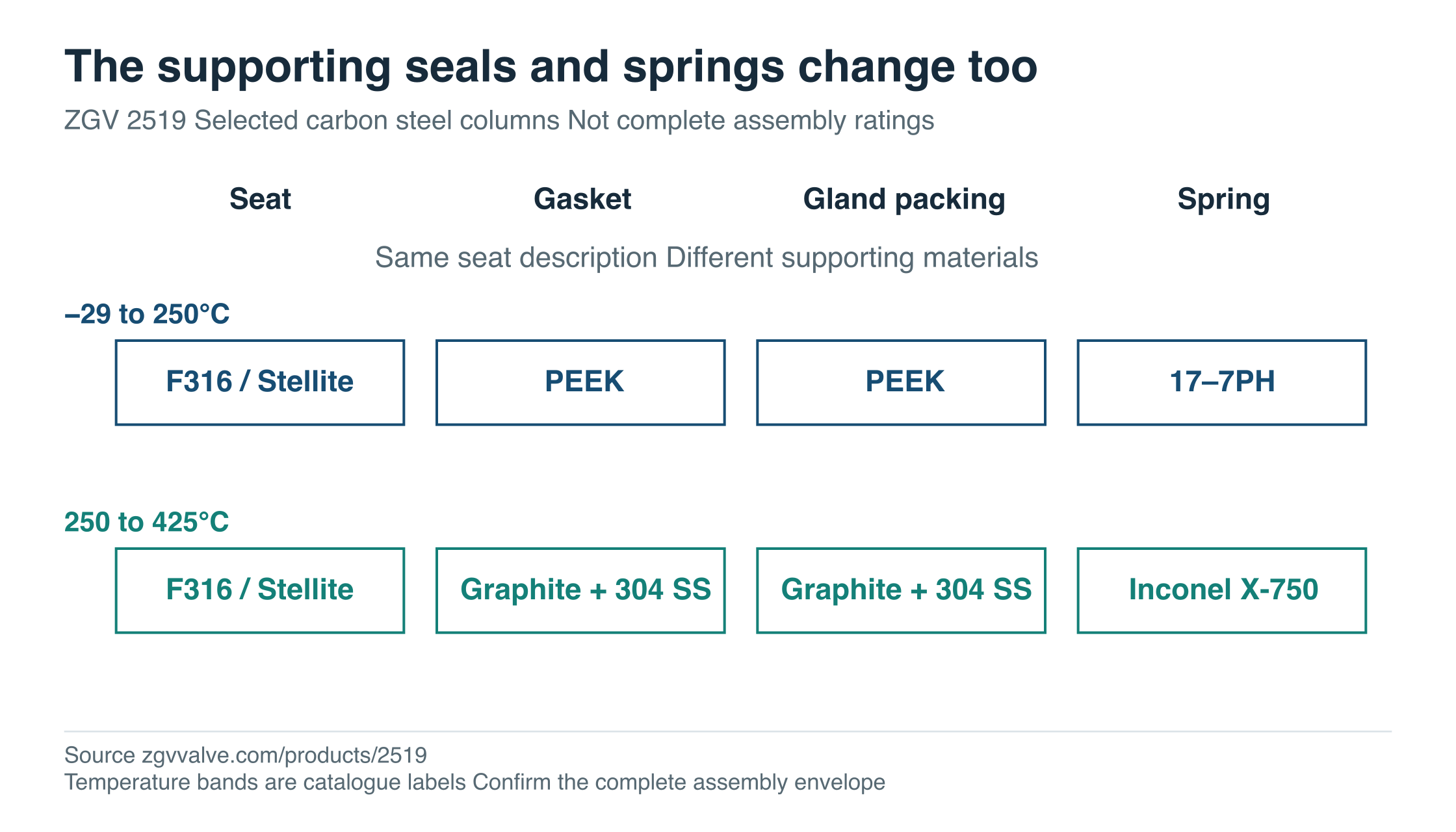
ZGV product 2519 groups its parts into four temperature/material columns. A short extract shows why reviewing only the ball-to-seat contact is incomplete.
| Component | Carbon steel −29 to 250°C | Carbon steel 250 to 425°C | Stainless steel −29 to 250°C | Stainless steel 250 to 550°C |
|---|---|---|---|---|
| Body | WCB | WCB | CF8M | CF8M |
| Ball | F304/coating | F304/coating | F316/coating | F316/coating |
| Seat | F316 / Stellite overlay | F316 / Stellite overlay | F316 / Stellite overlay | F316 / Stellite overlay |
| Gasket | PEEK | Graphite + 304 stainless | PEEK | Graphite + 316 stainless |
| Gland packing | PEEK | Graphite + 304 stainless | PEEK | Graphite + 316 stainless |
| Spring | 17–7PH | Inconel X-750 | 316 stainless | Inconel X-750 |
Scroll the table horizontally on a small screen.
Source: ZGV metal seated ball valve component table. Temperature bands reproduce all four catalogue column labels; they are not a complete pressure-temperature rating for an assembled valve.
The same nominal metal seat description appears in all four columns, while gaskets, gland packing and springs change. The two stainless steel columns keep the CF8M body but change those supporting parts. A metal seating surface therefore does not eliminate the need to check the other parts exposed to heat and loading.
The catalogue describes the ball as “F304/coating” or “F316/coating.” Where surface performance drives the selection, the technical offer should go further: identify the coating chemistry, thickness, hardness and finishing requirements relevant to the duty. A base-alloy description cannot supply those details.
The 250°C boundary in this particular table is also not a universal dividing line between soft and metal seats. It separates configurations in that catalogue. Using it as a general rule would skip the very pressure, temperature and material checks the selection needs.
Swipe or scroll horizontally to see the full diagram.
Four questions that change the comparison
Will particles reach the sealing surfaces?
Abrasive particles can make wear resistance important, but a “metal seated” description does not quantify resistance to the actual medium. Ask how particle size, hardness and concentration affect the proposed surfaces and operating method. A coating that suits one duty may not be the right response to a different combination of impact, corrosion and sliding contact.
For a soft seat, ask whether particles can embed in or damage the seating element and how that affects subsequent shutoff. For a metal seat, ask how the surfaces are protected and what evidence supports their use. Neither answer should rely on the body material alone.
Must the valve close under a large pressure difference?
Specify the differential pressure at the moment of opening and closing. Line pressure and operating differential pressure are different inputs. A valve may be open with high pressure on both sides but need to break away later with one side depressurised.
The torque review should cover the proposed seat and packing materials, the fluid and the temperature. A torque figure for a different trim should not be used to approve the actuator simply because the nominal size matches.
What does tight shutoff mean in the order?
Write the test standard, test medium, pressure, direction and acceptance requirement that apply to the offered valve. “Bubble tight,” “zero leakage” and “Class VI” are incomplete if detached from the test procedure and conditions. FCI explains seat leakage classes as benchmarks for control valves under defined tests; those classes should not be treated as a universal statement about every isolation valve. FCI explanation of ANSI/FCI 70-2
If shutoff after thermal cycling is a project requirement, state it separately from a routine cold production test. The supplier can then confirm the applicable qualification or propose a documented test arrangement. Do not assume that a cold test report answers the thermal-cycle question.
Which parts determine the full assembly limit?
The seat, body, packing, gaskets, bearings and operator need to be considered together. The offered assembly may have a more restrictive limit than one material selected from its parts list. A high temperature body alloy does not raise the allowable temperature of an incompatible auxiliary seal.
The same distinction applies to fire testing. A metal seat does not, by itself, prove that the assembled valve has the fire-test qualification the project requires. The relevant report must cover the offered design and its qualified scope.
Let the dominant failure mechanism guide the shortlist
For a clean service within the confirmed soft-seat envelope, the immediate comparison is shutoff, compatibility and operating load. An unspecified metal coating adds little to that review unless it addresses a requirement the soft-seat option cannot meet.
Where recurring particles damage seating surfaces, the comparison shifts to the actual wear mechanism and the proposed surface system. A quote should explain what changes at the contact surfaces and why those changes address the stated particles. A stronger body alloy alone would not answer that question.
Where thermal cycling drives the requirement, compare the complete hot configuration and its qualification basis. In the ZGV table, changing supporting seals and springs while retaining a similar seat description is a concrete reason to review the material schedule as a whole. A well-supported proposal connects each changed part to the condition it needs to withstand.
Make the duty visible in the enquiry
| Service detail | Why it changes the seat discussion |
|---|---|
| Fluid composition and cleaning chemicals | Body and sealing parts may have different compatibility limits |
| Solids size, concentration and behaviour | Wear, deposits and seating interference need a specific assessment |
| Temperature and pressure during each operating stage | Normal operation alone may not describe the most demanding condition |
| Opening and closing differential pressure | The operator must move the selected sealing arrangement at that duty |
| Required shutoff test and any thermal cycling | A routine test and an additional qualification answer different questions |
| Expected frequency and long idle periods | Both repeated movement and breakaway after standing may matter |
Scroll the table horizontally on a small screen.
Compare complete soft-seat offers that meet the stated duty. Where a requirement remains unmet, ask the metal-seat proposal to identify the surface and supporting-part changes that address that specific gap.
For a metal seated enquiry, start with the published ZGV material columns and ask which column and surface specification will be offered. For a soft seated enquiry, name the required compound or ask for the proposed compound to be identified. A useful supplier reply includes the complete material schedule, assembly rating, torque basis and shutoff acceptance conditions—not only a seat label.
Use the valve RFQ worksheet to organise the service conditions. Attach the proposed material schedule and the required shutoff or thermal-cycle acceptance basis. You can send the seat and material enquiry to ZGV.