
A labelled port-state map turns a routing intention such as one inlet and two outlets into a clear multiport-valve enquiry. Record the endpoint connections and what is permitted while the plug moves between them.
A multiport valve enquiry needs labelled ports, required endpoint states, permitted intermediate connections and the actual movement sequence. Confirm them on the offered passage drawing before selecting the operator or approving the valve.
ZGV's three-way/four-way plug-valve catalogue provides a dedicated starting point for diversion and routing enquiries. A labelled state schedule helps the quotation identify the required passage pattern, operator positions and checks for each flow path.
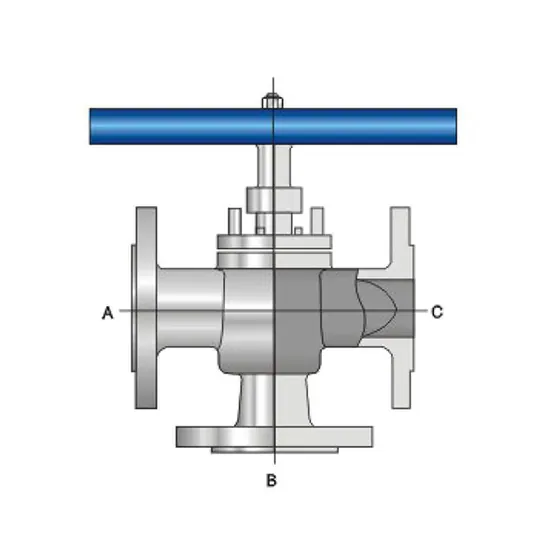
Give the ports names that survive the project
Label the common inlet A and the destinations B and C, or use the actual process line identifiers. Put the same labels on the piping sketch, passage drawing, control description and inspection records. Three photographs from different directions should not create three different definitions of left and right.
ZGV's three-way/four-way plug valve entry 2574 is a real catalogue reference. Its original illustration and dimensional information help define the routing enquiry. Ask for the proposed internal port drawing and engineering model, with the required passage pattern, all-closed state if needed and transition behaviour identified.
Also distinguish a multiport routing valve from a valve with accessory vent/drain connections. Counting every external connection does not identify the principal process flow pattern.
Write the endpoint states first
The following is an illustrative requirement for supplier confirmation, not a statement that a particular ZGV configuration provides all listed states.
| Required state | A–B | A–C | B–C | Additional requirement |
|---|---|---|---|---|
| Feed destination B | Open path | Required isolation | Required isolation | Define leakage acceptance on isolated paths |
| Feed destination C | Required isolation | Open path | Required isolation | Confirm direction and pressure cases |
| Optional all-closed state | Required isolation | Required isolation | Required isolation | Must be explicitly offered if required |
Use open path and required isolation deliberately. The actual flow capacity of an open path and the acceptance test of an isolated path still need to be specified. A diagram showing a line between ports is not a measured Cv curve or leakage result.
Intermediate positions can decide the purchase
A valve can satisfy both endpoints yet create an unacceptable connection during travel. For instance, two destinations may briefly communicate, or all paths may temporarily close. Which behaviour is acceptable depends on the process.
A make-before-break requirement permits or requires an overlap of defined paths. A break-before-make requirement creates an interval in which a previous connection is interrupted before the next is made. The exact behaviour must be confirmed from the offered passage geometry and movement, not inferred from the words three way.
Ask these questions:
- Can B and C communicate at any point in the commanded movement?
- Can the pump or source temporarily encounter a blocked path?
- Can a fluid pocket become trapped during the sequence?
- Is reverse pressure permitted in every relevant state?
- What state results if movement stops between endpoints?
These are design inputs. They do not authorise a routing sequence on an operating plant. The process designer must approve the resulting connections and safeguards.
Match the operator to the required states
A two-position actuator can be appropriate for a defined endpoint task, but it does not automatically supply an independent middle position. A four-way or lift mechanism can also require a movement sequence different from a simple 90-degree turn.
The operator drawing should identify travel, stops, direction of rotation and any lift/seat actions. Position indication and feedback need to correspond to the approved port states. A contact labelled valve open can be ambiguous where more than one useful routing position exists.
DeZURIK's multiport plug-valve description identifies different plug styles and flow combinations for its three-way and four-way designs. It provides a directly relevant example of why the internal passage pattern must be specified. For ZGV's lift plug reference 2573, confirm the actual movement and load sequence in its own drawing before selecting the operator.
Add a connection-specific acceptance table
The inspection plan should identify the paths to be checked in each required state, the pressure direction, test medium and acceptance basis. If intermediate overlap or interruption is critical, agree how the design or test evidence will demonstrate it.
| Verification item | Record that makes it reviewable |
|---|---|
| Endpoint routing | Labelled passage drawing and confirmed operator position |
| Isolation of unused destination | Defined connection pair, pressure direction and acceptance test |
| Transition behaviour | Approved angular/state map and relevant verification |
| Position feedback | Signal/indication schedule matched to actual port states |
| Failure or interrupted movement | Required condition and package response |
An endpoint indicator confirms an observed position within its arrangement. It does not by itself prove that an isolated internal path meets the leakage requirement.
Keep the state map with the order
A revised actuator orientation, plug pattern or port naming can change how a diagram is interpreted. Freeze the accepted drawing revision and state schedule with the purchase documents. Ensure the markings and handover instructions use the same labels.
The plug-valve mechanism guide covers lubricated, sleeved and lift arrangements. Here the additional decision is routing: which process connections exist in every relevant state.
At handover, use the accepted port labels to verify that local indication and remote feedback refer to the same physical route. An actuator installed in a different orientation can make an otherwise familiar indicator misleading unless its configuration and labels are reconciled.
Send the labelled port-state and transition schedule with the fluid, pressure, temperature and operator requirements. The quotation should confirm the actual paths and list unavailable states as deviations before approval.
ZGV VALVE · Zhejiang Zhonggong Valve Group Co., Ltd. · Quality and certification records
Download the ZGV valve RFQ template and share your service conditions, quantities and required documents with ZGV.