
Class 150 is a pressure-class designation. Reading it as a working pressure of 150 psi can produce the wrong selection; treating it as a single pressure valid at every temperature can do the same.
The usable rating comes from the applicable material, temperature, construction and standard, followed by the limits of the complete valve assembly. Class is one part of that identification.
Read the designation and the rating as separate information
ASME B16.34 covers pressure-temperature ratings and other construction requirements for valves. ASME B16.5 covers flanges and flanged fittings. Their public descriptions identify related but different objects; a flange designation is not a complete specification for every component of an assembled valve. ASME B16.34, ASME B16.5
The Class number identifies a rating class, while the pressure-temperature table supplies pressures for specified materials and temperatures. The applicable edition and construction category belong with that table. A material name without the relevant grouping or condition may be insufficient to choose the correct row.
The ASME pages list 2025 editions as of 16 October 2026. The manufacturer chart below is a separate reading example; its source, material and construction category remain part of the comparison.
A public table shows the temperature effect
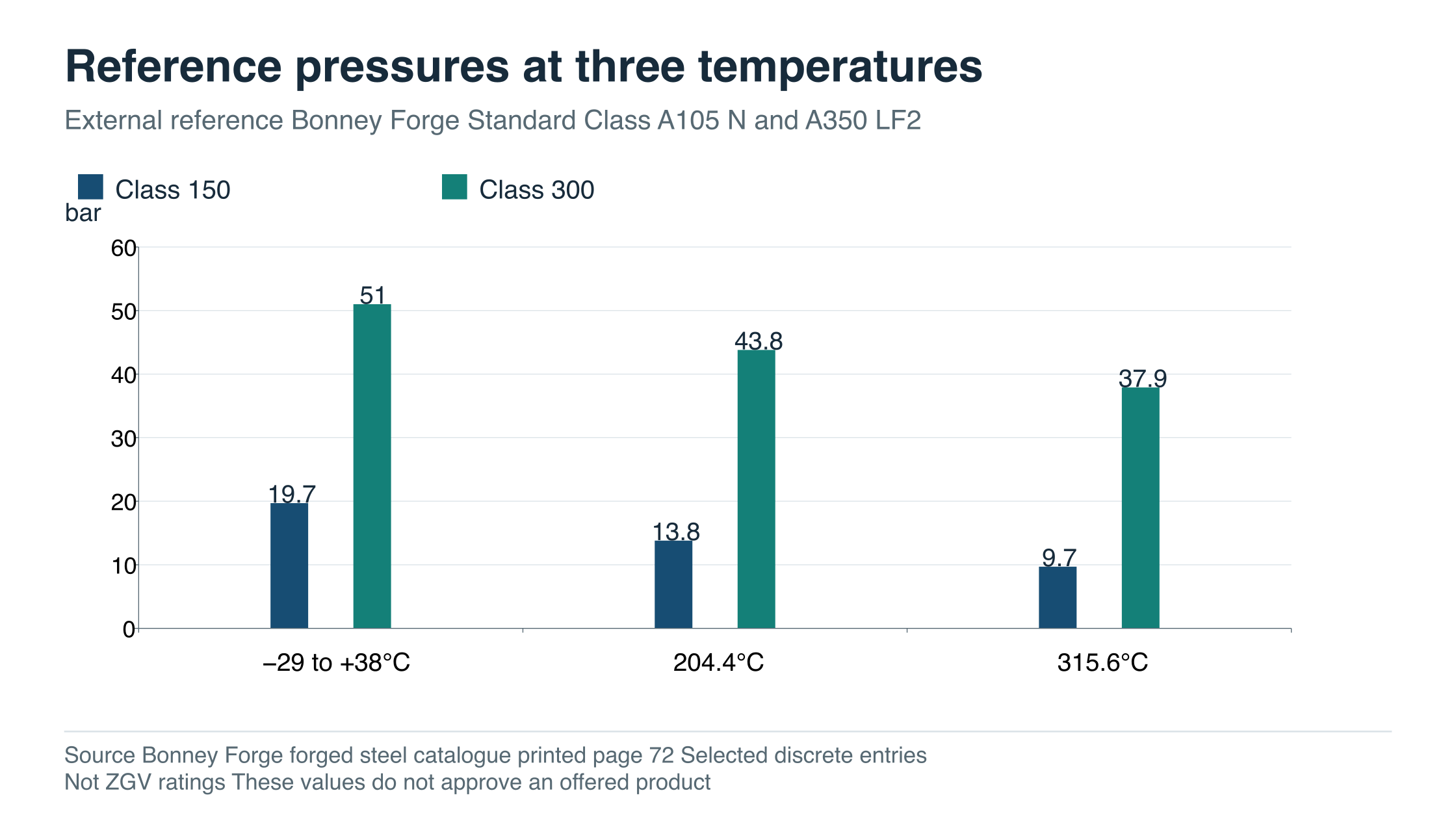
Bonney Forge’s forged-steel catalogue prints a pressure-temperature chart for ASTM A105 N and ASTM A350 LF2. The following values come from its Standard Class table, not the Special Class table printed on the same page.
| Temperature in the reference table | Class 150 pressure bar | Class 300 pressure bar |
|---|---|---|
| −29 to +38°C | 19.7 | 51.0 |
| 204.4°C | 13.8 | 43.8 |
| 315.6°C | 9.7 | 37.9 |
Scroll the table horizontally on a small screen.
Source: Bonney Forge forged-steel catalogue, printed page 72, PDF page 74. Values and units follow that manufacturer’s chart. This is an external reading example, not a ZGV rating table or approval for a proposed valve.
Within that reference table, the Class 150 pressure decreases as temperature rises. The class designation stays the same. At the listed 315.6°C point, its 9.7 bar value is less than half the 19.7 bar value printed for the lower-temperature band.
This gives a better way to read a quotation. A line saying only “Class 150, A105” does not answer the temperature-dependent pressure question. The exact body material, applicable construction category, complete assembly and intended operating points still need confirmation.
Swipe or scroll horizontally to see the full diagram.
Use a required operating point to read the table
Suppose, for illustration, a requirement is 30 bar at 315.6°C. Assume that the required pressure and the reference table use the same pressure basis.
In the manufacturer table above, the Class 150 value at that temperature is 9.7 bar, so it fails that particular pressure screen. The Class 300 value is 37.9 bar, so it passes that single screen. Passing the screen does not approve the complete valve, its seat, its connections or its suitability for the fluid.
The example also shows why a cold test pressure cannot stand in for a hot-service rating. The two numbers answer different questions. A valve’s ability to undergo a specified test at the test conditions does not establish its allowable pressure throughout the operating temperature range.
For the project calculation, replace these reference values with the offered valve’s rating information. Any permitted interpolation needs the applicable standard and manufacturer’s method; the discrete points in this example establish no separate interpolation rule.
Follow the restrictions through the complete assembly
A body-material rating is one constraint. The selected seat, packing, gaskets, bellows where present, end connections and relevant accessories may add others. The completed configuration needs to satisfy the service point within all applicable limits.
For example, ZGV’s Class 600/900 floating ball valve table lists an A105 body and R-PTFE seat. Those are separate material identifications. The body class and material do not describe the full seat assembly’s pressure-temperature envelope. Obtain that envelope for the actual offered trim.
A simple way to organise the review is to keep each requirement beside its evidence.
| Item in the review | Evidence required for the offered configuration |
|---|---|
| Pressure-containing construction | Correct material, construction category and pressure-temperature rating basis |
| Seat and auxiliary seals | Pressure, temperature, fluid and differential-pressure limits that apply to those parts |
| End connections | Applicable standard, facing and rating for the actual connection |
| Bellows or special bonnet | Relevant limits and operating conditions of that assembly |
| Operator and accessories | Environmental and service restrictions that affect the assembled package |
Scroll the table horizontally on a small screen.
The most restrictive applicable requirement may be different at different operating points. A single component’s maximum temperature, listed without the associated pressure and conditions, is an incomplete basis for the selection.
Keep pressure and temperature paired in the specification
A specification should show the combinations that actually need evaluation. Normal operation, start-up, cleaning and an identified upset may have different pressure-temperature pairs.
Record each operating stage as a pressure-temperature pair. If the governing design basis requires another combination, label it explicitly as a design requirement. This keeps mandatory design conditions distinct from values observed at different stages and gives the supplier a clear set of points to assess.
Keep pressure units and reference clear. bar g and bar absolute use different reference pressures. A supplier’s rating and a process requirement must be on a consistent basis before comparing their numbers. The same discipline applies when converting MPa, bar and psi; changing units cannot correct a missing rating basis.
PN and Class need a technical comparison
PN is a designation used in another standard framework; it should not be treated as a universal conversion from an ASME Class number. DIN EN 1333 addresses the definition and selection of PN for pipework components. DIN EN 1333 official listing
For example, an offer marked PN40 cannot be approved for an ASME Class 300 line merely by comparing the numbers 40 and 300. First, obtain each proposed configuration’s rating at the required temperature, with the material and standard identified. Second, compare the mating dimensions, facing and connection details. A proposal can pass the pressure-temperature comparison and still require connection changes. Similar pressure capability at one temperature does not make two flange systems dimensionally interchangeable.
An additional trap is Class 800. ZGV lists Class 800 bellows globe valves, while the ASME B16.5 flange classes in the public scope are 150, 300, 400, 600, 900, 1500 and 2500. A Class 800 valve enquiry therefore still needs the exact end-connection specification; the number does not create a B16.5 Class 800 flange.
Treat test pressure as a different field
ZGV’s lift plug valve catalogue lists separate shell and sealing test pressures. For its Class 150 row, those values are 3.0 MPa and 2.2 MPa. They are catalogue test entries. They are not a hot operating-pressure rating, nor proof that an individual order has already been tested.
In the purchase documents, keep pressure class, pressure-temperature rating, operating differential pressure and test pressure in separate fields. A supplier’s answer is much easier to review when those fields are not collapsed into “maximum pressure.”
For a ZGV selection, supply the mandatory pressure-temperature pairs, medium and connection standard. Request the formal rating basis for the complete offer so the supplier can identify the rated configuration and the limits that govern it.
List the mandatory pressure-temperature pairs and governing design conditions with the valve RFQ worksheet. Keep the requested rating evidence separate from the test-pressure fields. You can request the rating information for your ZGV enquiry.