A valve spare parts RFQ should identify the installed assembly, the item or kit required, and the conditions the replacement must satisfy. Begin with the manufacturer, model and serial or order reference. Add the applicable drawing or parts-list revision, part description and number, quantity, materials and service conditions. A photograph, nominal valve size or the words seat kit rarely establish the whole requirement.
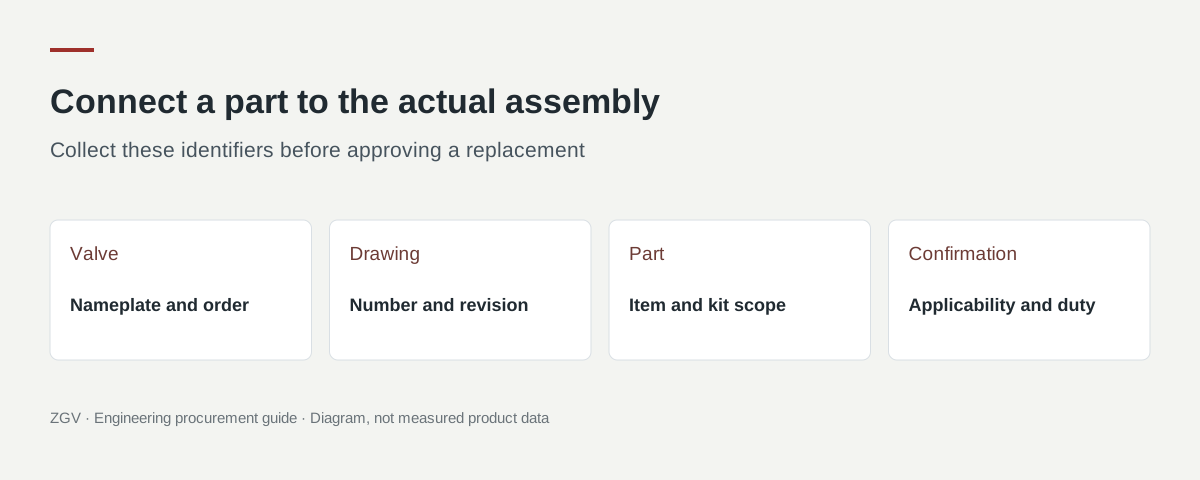
This guide helps maintenance and procurement teams prepare a replacement-parts request. It is an identification and quotation framework, not a disassembly procedure or a promise that a named supplier can provide a particular part. The manufacturer must confirm the proposed replacement for the identified assembly, and the responsible project team must approve any change.
Start with the valve identity, then name the component
A valve family can contain different sizes, pressure ratings, seats, stem arrangements and design revisions. Find the records that describe the installed unit before choosing from a generic list of parts.
Emerson's Fisher maintenance-packing manual requests the valve serial number together with the part description and part number when ordering the covered components. That example distinguishes identifying the assembly from identifying an item in its parts list. It does not establish Fisher part numbers or packing arrangements for a ZGV valve. Fisher manual D104566X012, page 5
Collect the following identification evidence while the equipment can be safely observed. Opening or dismantling a valve solely to obtain an enquiry photograph requires an authorised maintenance plan, isolation and competent personnel.
| Identification field | Useful evidence | What it helps establish |
|---|---|---|
| Manufacturer and actual model | Readable nameplate, order record or approved datasheet | Which product design the enquiry concerns |
| Serial, order or manufacturing reference | Nameplate and original documents where available | The manufacturer's route to the supplied build |
| Site tag | Plant equipment register and location | Which physical plant item needs the part |
| Size, rating and connections | Nameplate, approved drawing and order | The applicable configuration and installation interface |
| Drawing and revision | Accepted sectional drawing or parts list | Which component numbering and assembly arrangement apply |
| Modifications since supply | Approved repair or modification records | Whether the original build still describes the installed item |
Keep photographs labelled by assembly and view. A close-up of a loose ring without the valve identity can create an attractive image and an unusable enquiry.
Treat a drawing item number and a part number as different fields
A number beside a component in an exploded drawing is often a location key. It may point to several part-number variants in a table, depending on size, material or construction. Do not assume that item 5 uniquely identifies a purchasable component across every model or revision.
For each requested item, retain this chain:
Assembly identity → drawing revision → item description/key → supplier-confirmed part number and revision → required quantity.
Where the part number is unknown, label it unknown and supply the available evidence. Ask the manufacturer to identify it. Turning a local stock code into an assumed manufacturer part number makes later verification harder.
Schroeder Valves' own technical-support page describes using its valve identity, IOM, dimensional drawing and bill of materials to identify parts. It also asks buyers to disclose changed process data when considering an as-built replacement. Its service scope belongs to Schroeder; the useful procurement principle is to reconnect the requested item to the actual build and current duty. Schroeder technical support
Define what seat kit or seal kit actually includes
Request a contents list with quantities, descriptions and applicable drawing references. A kit name is not a complete bill of materials. Confirm whether the quotation covers individual parts, a complete assembly or an agreed set for a particular maintenance task.
| Request wording | Clarification to obtain |
|---|---|
| Seat kit | Seat configuration, actual material/compound, included supporting components and quantity |
| Seal kit | Which stem, body, bonnet or other sealing locations are covered |
| Packing set | Packing arrangement, dimensions/variant and associated parts required for the identified build |
| Stem assembly | Included components, interfaces and any required matching or assembly controls |
| Operator repair kit | Exact operator identity, module/kit reference and supplied contents |
| Recommended spares | Maintenance task or operating plan the recommendation is intended to support |
Spirax Sarco's M70i/M80i manual identifies separate spare sets for specified constructions and asks for the valve size, type and listed spare description. It provides a concrete example of why buyers should use the manufacturer's actual kit definition. Its contents are not a generic list for all ball valves. Spirax Sarco manual, sections 6.3–6.4
Confirm materials and duty before accepting an alternative
For a seal, seat or other service-sensitive component, request the actual specified material or compound and the basis for its compatibility with the identified valve and operating duty. A broad label such as PTFE, stainless steel or equivalent should not close a requirement that calls for a more specific construction.
Provide the current medium, relevant concentrations or contaminants, temperature and pressure conditions, and the maintenance problem being investigated. Include cleaning exposure or a changed operating cycle when relevant. Distinguish recorded conditions from estimates.
A replacement can fit physically while leaving unanswered questions about service suitability, sealing performance or operating load. Ask the manufacturer to address those consequences for any proposed change. For a valve-seat comparison, the soft-seat versus metal-seat guide explains why the seat choice belongs to the actual service and complete configuration.
Do not select a new material merely to make the parts enquiry proceed faster. Record an alternative as a proposed deviation until its evidence and approval are complete.
Identify an actuator or accessory independently
An automated valve can include components supplied by different manufacturers. A valve nameplate may not identify the actuator's electrical build, control module or accessory revision. Capture each relevant nameplate and link it to the assembled package.
Rotork's CK spare-parts manual requires the actuator type and serial number for a spares module and describes nameplate details as useful for checking the specification. That requirement concerns Rotork's CK equipment. It is evidence for collecting a separate operator identity, not a claim that a ZGV valve has a CK actuator. Rotork CK spare-parts manual, pages 2–3
For an operator-related enquiry, add the actual supply, mounting and coupling information, accepted settings, accessory identities and required failure/restart response as applicable. The manufacturer should identify any configuration or verification work required after replacement. The cause-and-effect guide keeps that response attached to a defined event.
Describe the maintenance task without claiming a diagnosis
Separate the observed symptom, the suspected cause and the requested procurement scope. This prevents an unverified diagnosis from becoming the only part a supplier is asked to quote.
For example, a fictional valve tagged V-17 has reported leakage during a planned isolation check. The maintenance team suspects a seat issue but has not completed its investigation. A useful enquiry identifies the assembly, records the observation and its test conditions, requests identification of the relevant spare options, and states that the final repair scope awaits engineering review. It does not declare the seat defective from a single symptom.
For planned shutdown stock, explain whether the request concerns routine maintenance, a known repair or critical contingency stock. Ask for the manufacturer's recommended scope for that task. Do not convert one recommendation into a universal annual replacement interval or a fixed spares percentage for the entire plant.
Use a response schedule to compare quotations
Send the same evidence and revision to each appropriate supplier. Keep the requested identity beside the offered identity, and make omissions visible.
| Quotation line | Supplier response to request |
|---|---|
| Assembly applicability | The exact model/build or identity to which the offered part applies |
| Offered part | Part number, revision, description and quantity |
| Kit contents | Included and excluded components |
| Materials | Specified material/compound and proposed differences |
| Replacement status | Direct replacement, superseded reference or alternative requiring review |
| Supporting documents | Applicable instructions and agreed identification/inspection records |
| Supply basis | Availability, stated lead-time trigger, quotation validity and delivery scope |
| Open condition | Further identification, inspection or engineering decision required |
A superseded part number needs a stated connection to the old reference and confirmation of applicability. An image showing a similar shape is not that confirmation. Use the quotation deviation register to retain unresolved differences through the purchase decision.
Keep the accepted part linked to receipt and maintenance
When parts arrive, compare labels, quantities and agreed documents against the approved quotation. Preserve the package-to-part association and relevant storage instructions. A supplier invoice or a seal's appearance alone does not establish every requested material or performance characteristic.
Carry the accepted part identity and any approved revision change into the maintenance record. After installation, complete the verification required by the applicable instructions and site procedure. Record any changed settings or assembly details. Procurement closeout and release of the repaired valve to service are separate decisions.
Send a specific ZGV enquiry
For an existing ZGV valve, include the original order reference, readable identification, approved drawing and the component or maintenance task concerned. If only a website reference is known, say so. Product 2514 identifies a published trunnion ball-valve configuration; it does not identify the unique assembly installed at a site.
For a replacement-valve enquiry, start with the relevant product family and identify the existing interfaces and service requirements. The top-entry versus three-piece guide can help define maintenance-access constraints.
Ask ZGV to review the identified requirement. Request confirmation of applicability, available supply scope and supporting information before ordering. This article makes no claim that ZGV stocks or supplies parts for every historic valve or another manufacturer's equipment.
Download the ZGV valve RFQ template and attach the operating cases, configuration identity and required documents to your enquiry.
Catalogue references for your enquiry
2511: Two piece floating ball valve Class150/300; 2567: Triple eccentric metal hard seal wafer or flange connection butterfly valve Class150; 2550: Bellows globe valve Class150/300. These published entries help identify a proposed configuration. They do not confirm interchangeability, an installation or repair procedure, or parts availability for the actual assembly. Ask ZGV to confirm the applicable documents and supply scope.