
An NPS 3 ball valve can have a listed passage of 76 mm or 51 mm and still occupy the same 203 mm length in a Class 150 line. That difference is easy to miss when two quotations both begin with “3 inch ball valve.”
Full bore and reduced bore describe the flow passage. They do not, by themselves, establish the pressure rating or flow coefficient. Compare the actual minimum passage with the process, cleaning and installation requirements.
Read the bore designation before comparing prices
In a full bore ball valve, the passage is intended to provide an opening corresponding to the valve’s nominal size. A reduced bore design uses a smaller passage within the same nominal end size. The actual minimum bore still needs to be checked against the specified product standard and the approved drawing; the word “full” is not a substitute for a dimension.
ZGV’s reduced bore tables use descriptions such as 3×2×3. In that table, the end-size designation is 3 inches while the smaller passage is associated with the middle size. The same row separately lists d = 51 mm and D = 76 mm. Those two letters should stay attached to their values when the quotation is clarified. Simply recording “76 mm” would lose the smaller passage that prompted the comparison. ZGV Class 150/300 trunnion ball valve data
Ball support and bore size are separate choices. A trunnion mounted valve can still require a full or reduced bore decision. If the support arrangement is also undecided, the floating and trunnion ball valve comparison explains that earlier choice.
A comparison from the same catalogue families
The following entries are published dimensions, rather than measurements of delivered valves. The Class 150 entries come from ZGV product 2514; the Class 600 entries come from product 2515.
| Catalogue configuration | Listed passage mm | Length L mm | Height H mm | Listed weight kg |
|---|---|---|---|---|
| Class 150 NPS 3 full bore | D 76 | 203 | 193 | 33 |
| Class 150 3×2×3 reduced bore | d 51 | 203 | 165 | 30 |
| Class 600 NPS 3 full bore | D 76 | 356 | 247 | 50 |
| Class 600 3×2×3 reduced bore | d 51 | 356 | 176 | 41 |
Scroll the table horizontally on a small screen.
Sources: Class 150/300 dimensions and Class 600/900 dimensions. H is the catalogue drawing dimension; it is not a promised complete assembly height. Operator arrangement and the scope included in each weight require confirmation.
Within each pressure class, the full and reduced bore entries have matching L but different H and listed weights. The Class 150 reduced entry is 3 kg lighter than the 33 kg full bore entry, a calculated reduction of 9.1%. The Class 600 difference is 9 kg against 50 kg, or 18.0%. These percentages describe the selected catalogue weights; they are not a price or complete-package weight comparison. The same installed length can therefore conceal a different passage and handling requirement.
For a replacement, keep two approval items on the enquiry: the connection and installation fit, and the passage required by the process. Matching L answers only one part of the installation review.
What the diameter difference means geometrically
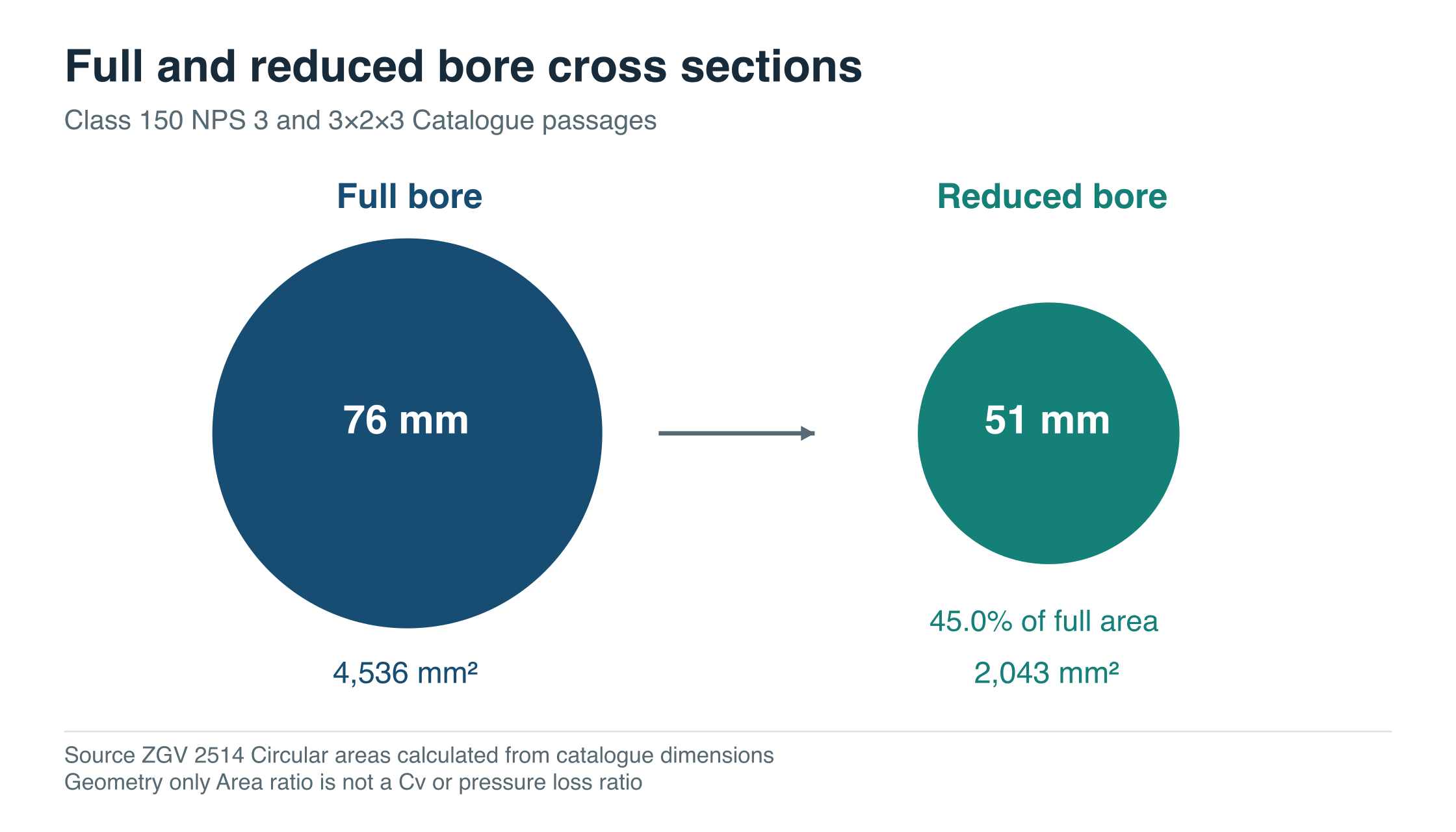
For a circular passage, area is πd²/4. Using the two catalogue passage dimensions above gives:
| Calculation | 76 mm passage | 51 mm passage |
|---|---|---|
| Circular area | approximately 4,536 mm² | approximately 2,043 mm² |
| Area relative to the 76 mm passage | 100% | approximately 45.0% |
| Mean velocity at an assumed liquid flow of 30 m³/h | approximately 1.84 m/s | approximately 4.08 m/s |
Scroll the table horizontally on a small screen.
The flow in the last row is an illustrative assumption, not a ZGV capacity rating or flow test. It uses the same incompressible volumetric flow at the two circular sections and ignores other restrictions. At that assumed flow, the smaller section has about 2.22 times the mean velocity because its area is smaller.
That is a useful explanation of the geometry. It does not mean that the reduced bore valve has 45% of the flow capacity, produces 2.22 times the pressure drop or consumes a specified percentage more energy. Flow coefficient also depends on the complete internal shape and the conditions under which it is determined. Transitions into and out of the passage matter.
The distinction becomes especially important when a supplier offers a Cv value from another valve size or design. A reduced bore designation and a nominal size are insufficient to identify the relevant flow coefficient. The purchaser needs data for the offered configuration.
The area reduction is also specific to the row being compared. Three Class 150 pairs from the same ZGV table illustrate the difference.
| Class 150 nominal end size | Full bore D mm | Reduced bore d mm | Reduced area divided by full area |
|---|---|---|---|
| NPS 3 | 76 | 51 | 45.0% |
| NPS 4 | 102 | 76 | 55.5% |
| NPS 6 | 152 | 102 | 45.0% |
Scroll the table horizontally on a small screen.
Source dimensions: ZGV product 2514 full and reduced bore tables. Percentages are calculated circular-area ratios, rounded to one decimal place.
The NPS 4 pair retains a different area proportion from the NPS 3 pair. “Reduced bore” therefore cannot be converted into a fixed percentage reduction for a whole family. Compare the minimum passage stated in each actual offer; keep any flow-capacity comparison tied to configuration-specific Cv or Kv.
Swipe or scroll horizontally to see the full diagram.
Decide whether pressure loss is material to this duty
For a clean liquid at a defined operating flow, an engineer can use the correct valve flow coefficient and the applicable sizing method to check pressure loss. A spreadsheet containing only nominal size and bore diameter cannot replace that calculation. Gas, steam, flashing liquids and two-phase flow require their own treatment; the simple liquid velocity example above should not be extended to them.
Spirax Sarco’s selection guidance identifies pressure loss as a reason to consider full bore and explains that valve sizing depends on the flow coefficient and service conditions. It does not make the catalogue bore a universal pressure-loss calculation. Isolation valves with rotary movement
The practical buying question is the pressure loss the system can tolerate at its relevant flow rates. A small difference may be acceptable on an infrequently used auxiliary line. On a continuously operated pumping line, even a modest additional loss may deserve a lifecycle cost calculation. Neither conclusion can be assigned from the product name alone.
For an energy comparison, ask for the predicted difference in pressure loss at the same flow, along with operating hours and pump efficiency assumptions. This makes the comparison traceable. A general claim that full bore “saves energy” is too incomplete to price into a project.
Check cleaning and installation requirements separately
Where a cleaning pig or inspection tool must pass, obtain a written confirmation of the complete passage, transitions and any other restrictions relevant to that tool. A full bore label alone does not establish piggability. The tool specification, actual pipe inside diameter and complete route all matter.
Where solids or deposits are present, describe them rather than assuming that either bore type will solve the problem. Particle size, concentration, adhesion and the operating sequence can affect what needs to be evaluated. A wider bore does not establish the suitability of the seat system or cavity arrangement.
For an existing line, inspect the end connection as carefully as the bore. Nominal size and pressure class do not identify the facing, flange drilling, pipe schedule, internal transition or operator clearance. A reduced bore valve can fit the nominal flange size while presenting a different internal restriction.
The dimensions table also deserves a final check against the offered operator. A hand lever, gearbox or actuator may change the space needed around the stem. Use the supplier’s assembly drawing for that check, with the valve in its installed orientation.
Compare the quotations on the missing evidence
| Requirement in the project | Evidence to request from each supplier |
|---|---|
| Limit pressure loss at operating flow | Configuration-specific Cv or Kv and a calculation using the stated fluid conditions |
| Pass a cleaning or inspection tool | Minimum passage and transition drawing with confirmation against the specified tool |
| Fit existing pipework | Approved end-to-end or face-to-face dimension, connections and complete operator envelope |
| Compare lifecycle cost | Price plus an agreed pressure-loss basis, operating hours and maintenance assumptions |
| Preserve a defined bore requirement | Minimum bore dimension and the applicable product-standard requirement in the offer |
Scroll the table horizontally on a small screen.
A lower purchase price for a reduced bore option may be entirely reasonable when the process calculation and project requirements support it. A full bore option may be justified where the passage or pressure loss is a binding requirement. The decision becomes clearer when both offers answer the same questions.
For a ZGV enquiry, identify the required size and class, state full or reduced bore explicitly, and attach the flow conditions and allowable pressure loss. The Class 150/300 and Class 600/900 product tables provide starting dimensions. Ask for the drawing and flow data for the actual configuration before approving it.
Use the valve RFQ worksheet for the base enquiry. Add the required bore, flow conditions and allowable pressure loss, with any cleaning-tool specification attached. You can request a bore-specific quotation from ZGV.